Stumblin' Along 5/24 '26
Travelin' Soldier

Travelin’ Soldier
- Hoboken’s WWI Rock
- Harlem Hellfighters
- Yanks Week 9 Notes
- YouTube Rabbithole
Alright @YouTheReader,
With it being Memorial Day Weekend, today’s tune is Travelin’ Soldier by The Chicks. Way back in the summer of 2004, my parents bought this CD for a 12-hour road trip.
They decided to play this song and Landslide over and over and over and over and over and over and and over and over and over and over and over and and over and over and over and over and over and over and over and over and over and over and over and over and over and over and over and over and over and over and over and over and over and over and over and over and over again. So it’s fully ingrained in my head.
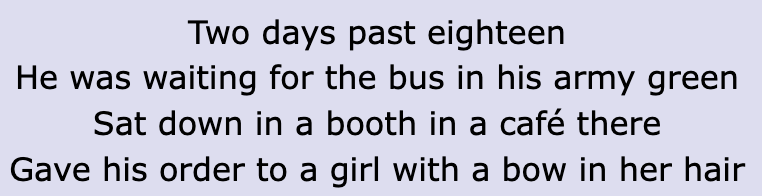
Country Music singer-songwriter Bruce Robinson wrote this song in 1996. He set Travelin’ Soldier during the Vietnam War, but he was in the Army Reserves in the early ‘90s. Robinson told SongFacts….
“I was working in a kitchen in Austin when we were getting called up in the reserves for the first Iraq War. And generally, that was the situation that started me thinking about that. I set the song in Vietnam, but those were the things that I was thinking about. If you’ll recall, it took a long time for us to send all the people over, and there were months of amassing our forces over in Kuwait in the first Gulf War. Those were the thoughts going through my head.”
The Chicks’ cover of Travelin’ Soldier landed #1 on the Country Billboard and reached #25 on the US Billboard Hot 100. An all-time sad song, but a good one for sure.
On to some history…
Hoboken’s WWI Rock
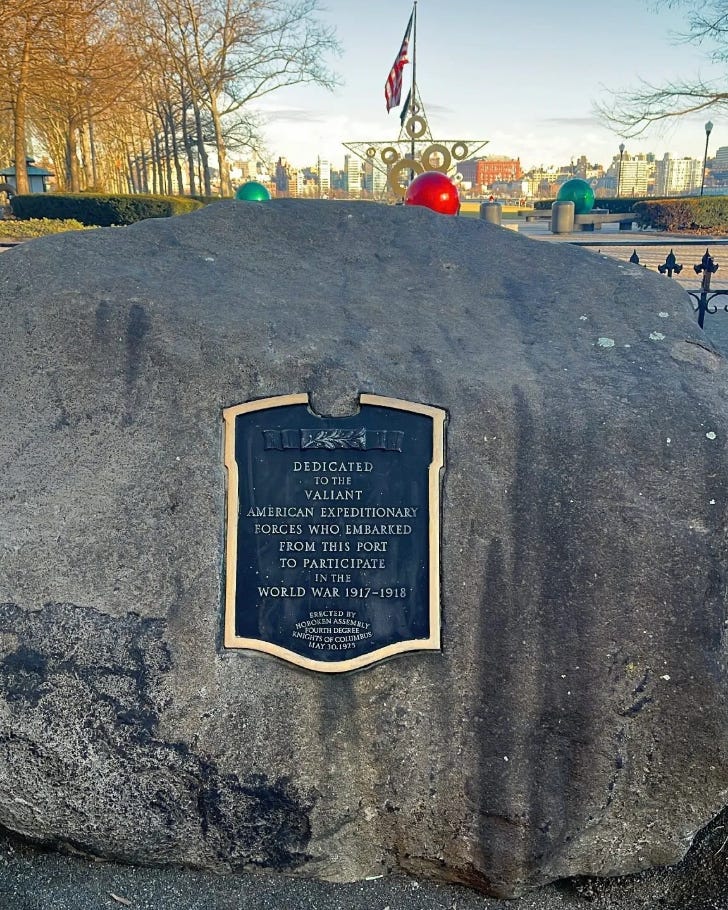
In U.S. history, World War I is often overlooked. That’s likely because the United States didn’t get involved until the tail end of it, and we also didn’t get attacked on US soil like Pearl Harbor. The only threat the US faced was the Zimmermann telegram from Germany that asked Mexico to invade & reclaim Texas, plus a few German U-boats sank American passenger ships. That said, the United States’ involvement in the Great War began in Hoboken, New Jersey, as it was the Port of Embarkation.
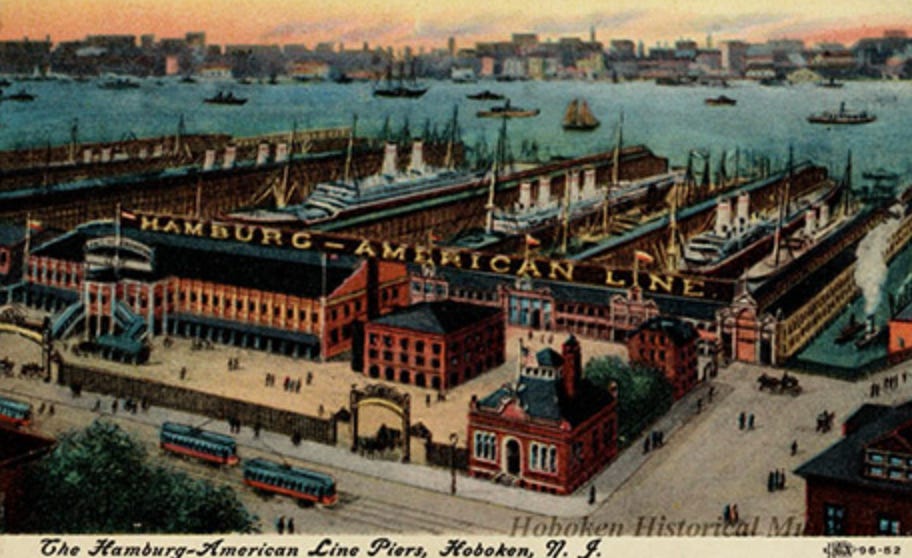
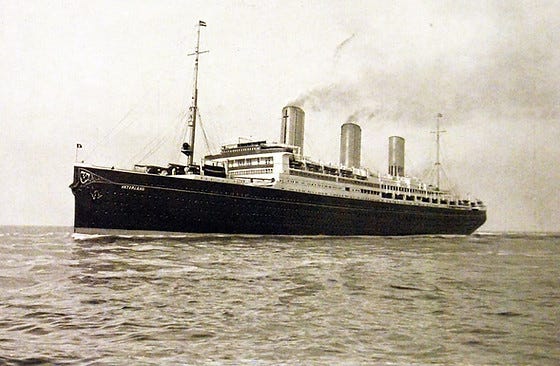
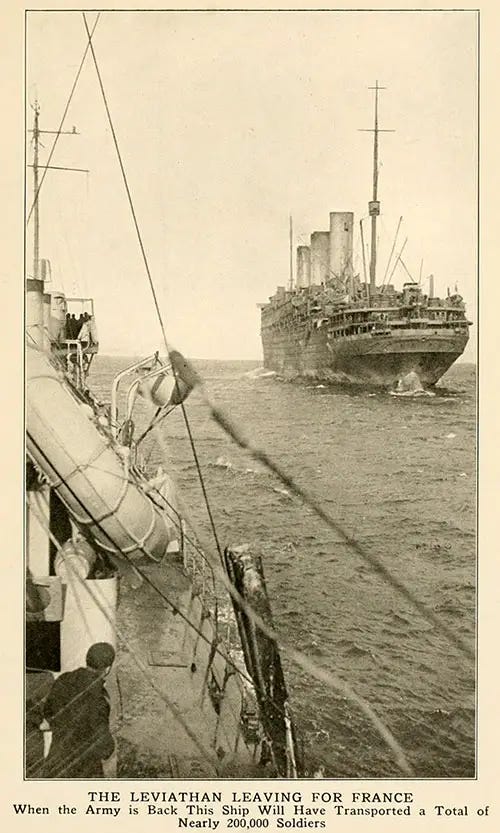
In 1910, Mile Square City was a German town with a population of 70k, 10k of whom were German-born. At the start of the war, Germany was still trading with the US and even docked the Hamburg-American liner “Vaterland” at Hoboken’s harbor. It was the largest ship in the world at the time, which weighed 58,000 tons. During the war, Britain eventually took control of the Atlantic Ocean, placing a blockade over the ports of Hoboken and New York City. Thus, the Vaterland was painted over in camouflage, renamed USS Leviathan, and found a home at the ports of Newark, New Jersey. Once the US entered the fray, the massive German ship was used against them, as over 120,000 American soldiers sailed on it to Europe.
One of the adverse effects of WWI on the US was that German Americans faced some unfair treatment based on where they were from. Shipyard dock workers were fired by the thousands, as many of them were of German, Austrian, and Hungarian descent. There was even a federal order that prohibited “enemy aliens” from living, working, or traveling within one hundred yards of docks, piers, and waterfronts, causing thousands of evictions on Hudson and River Streets. Every German-born or child of German immigrants was required by the US to register as an “enemy alien.” This targeted roughly 500,000 German-American citizens. As a result, by the end of World War I, Hoboken was no longer considered a predominantly German American town, as many residents had fled the militarized city.
(Source: Hoboken Historical Museum)
WWI American Soldiers were known as “doughboys.” The nickname had a different connotation than what we think today, as American soldiers weren’t slanging drugs, and the Pillsbury Doughboy didn’t start appearing in commercials until 1965. While the origins of the name aren’t exact, the History Channel gives two cases:
1) In the Mexican War of 1846-48, American infantrymen made long treks over dusty terrain, giving them the appearance of being covered in flour or dough
2) Continental Army soldiers who kept the piping on their uniforms white by applying clay. When the troops got rained on, the clay on their uniforms turned into “doughy blobs,” supposedly leading to the doughboy moniker.
Great nickname, and much better than the French, who were known in WWI as “poilus” (“hairy ones”) because of their mustaches and beards. The British also had a solid nickname, “Tommy”, not because of Tommy Shelby, but as an abbreviation of Tommy Atkins, a generic name (similar to John Doe) used on government forms.
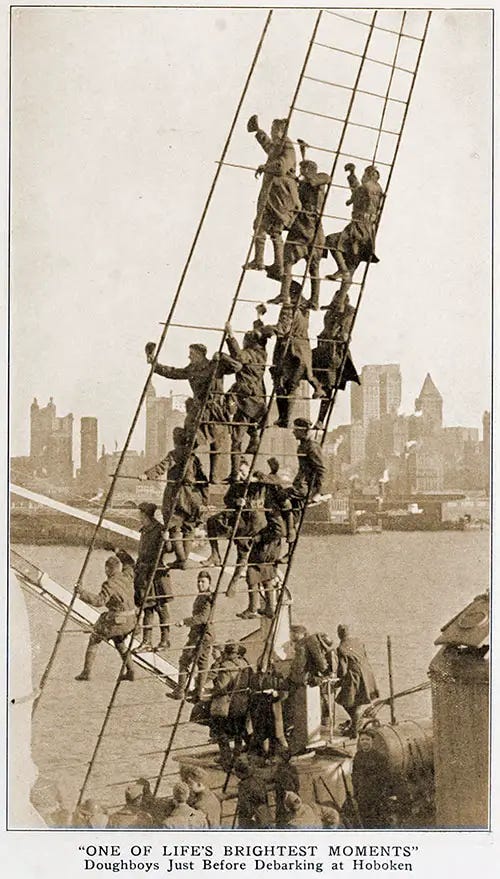
One of the first moves the United States made after declaring war on Germany on April 6, 1917, was to seize and convert German-owned shipping piers in Hoboken into the port of embarkation for the U.S. Expeditionary Forces. The first convoy set sail from Hoboken to Europe on June 14, 1917, and it gave the Mile Square across from Manhattan a bit of national fame. US General John J. Pershing famously promised the soldiers that by Christmas of 1917, the Doughboys would see “Heaven, Hell, or Hoboken.” All in all, Hoboken was the beginning of 936 voyages to Europe, and over 2 million Doughboy Americans passed through Mile Square City between the spring of 1917 and the fall of 1918.
Another little-known fact is that Prohibition actually began a bit earlier in Hoboken, New Jersey. All the Doughboy soldiers, who made up the majority of the city’s population during WWI, were prohibited from drinking. The Army successfully shut down all but 60 of the city’s 338 saloons in Hoboken. Holy shit, that’s a lot of fine drinking establishments to get a pint from! (Source: World War I Centennial)
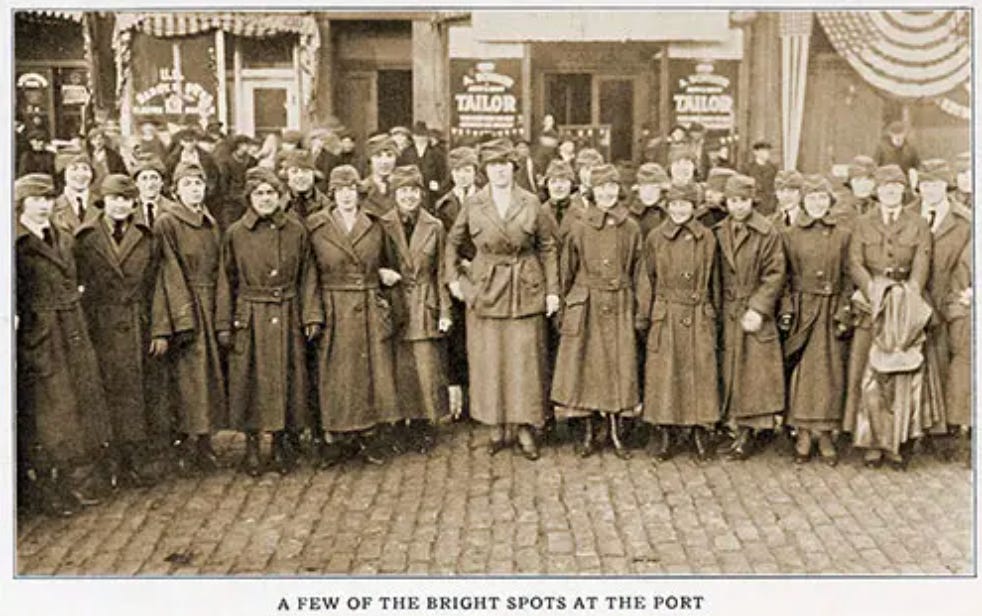
Hoboken didn’t change just for the Doughboys in WWI, as women were also affected by the town’s unofficial status as a military base. Women could not walk the streets after dark, or they would face charges of prostitution. Pretty extreme measure. At least during the day, some women in Hoboken experienced positive effects of WWI as they could work for the Salvation Army. Those women were given the nickname Lassies. Some of the Lassies even joined the men on their trip to Europe, where they would be given another nickname, “Doughnut Girls.”
(Source: Hoboken Historical Museum)
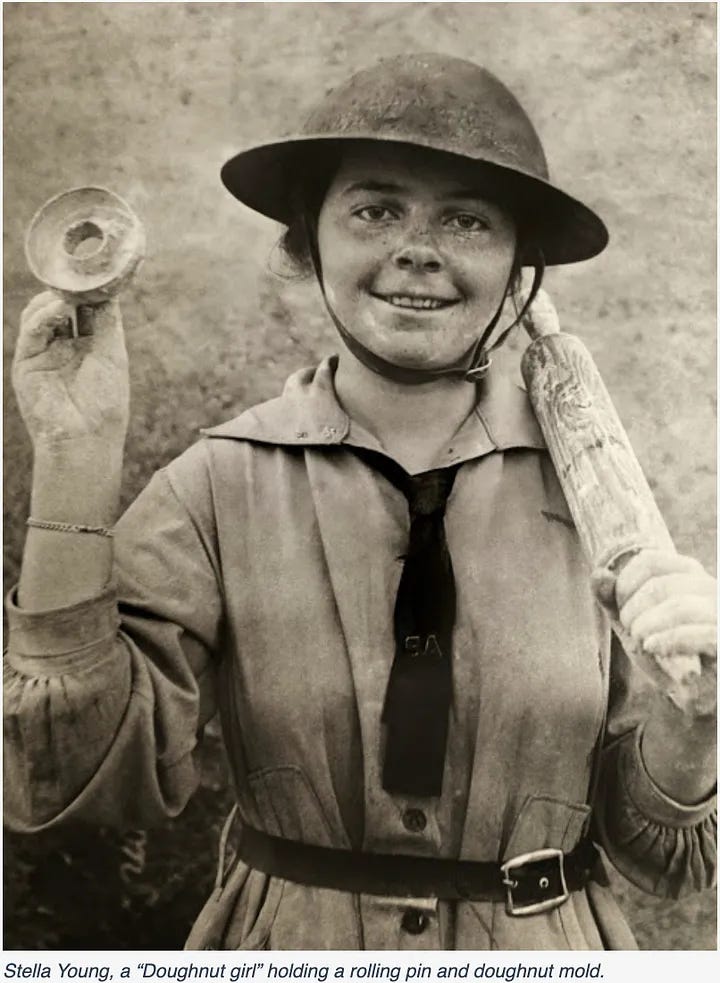
Doughnut Girls would bake apple pies and donuts for the Doughboys on the front lines. Stella Young, the young lady pictured above, became the poster girl of the Doughnut Girls. In 1919, the song “My Doughnut Girl” had Stella Young gracing the cover of the sheet music.
“As a doughnut girl, Stella was committed to doing her part to provide a touch of home and comfort to the soldiers. Often, this meant doing so in the midst of shelling and with the horrifying results of war within earshot and plain sight. On one occasion, while she was mixing a batch of doughnut batter, a shell exploded sending shrapnel into the shelter. Stella had just gone to get some sugar when a piece of shrapnel landed in the frying pan near where she was just working. She kept that piece of shrapnel as a souvenir for the rest of her life.”
Aside from donuts, women during WWI also played a key role in operating early 1900s phone lines during the war. They were nicknamed “Hello Girls” and were responsible for painting over the Vaterland, converting it into the USS Leviathan.
(Source: Everett Independent & Unwritten Record)
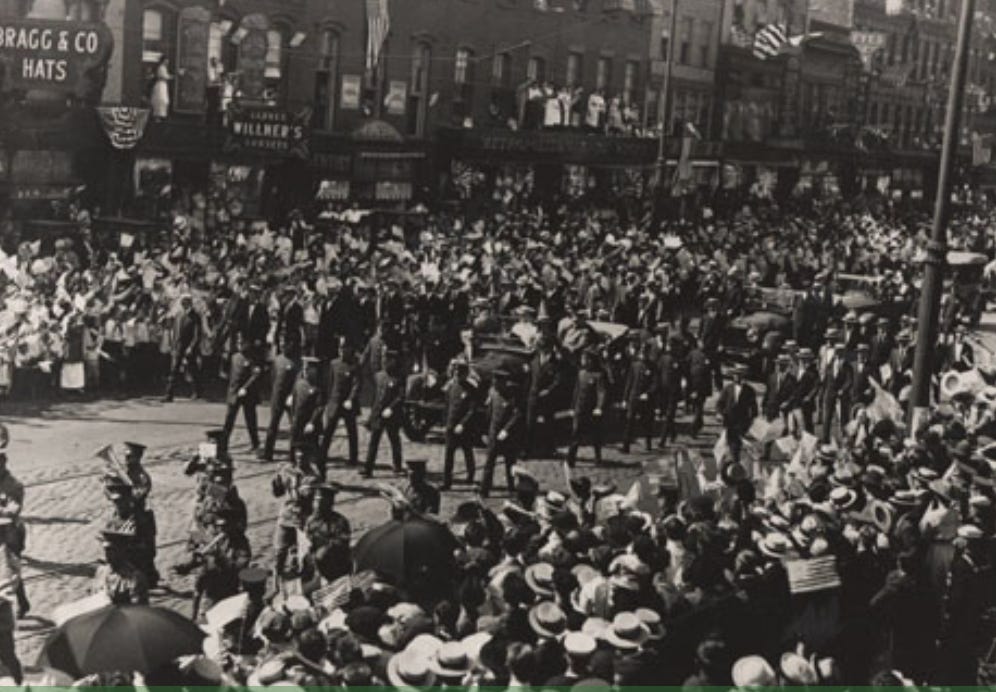
After the armistice was declared on November 11, 1918, Hoboken became the spot of celebration and mourning in the US. The Doughboys began making their way back to Hoboken on December 2, 1918. General Pershing finally arrived in Mile Square City on September 8, 1919, as the Treaty of Versailles was signed on June 28, 1919. Thus, President Woodrow Wilson didn’t dock back in Hoboken until July 8, 1919. He was met with celebration as Wilson paraded down Washington Street in a car, wearing a top hat. Lastly, the bodies of the fallen soldiers of the First World War started coming home on November 13, 1919. Over 50,000 Americans died in combat, and thousands more died from diseases, the main being the Spanish Flu that they brought back with them. On May 24, 1921, President Warren G. Harding visited Hoboken to attend a ceremony for the deceased.
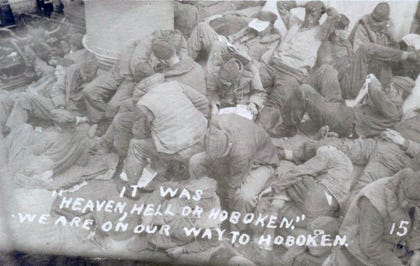
“Heaven, Hell, or Hoboken” is also a tough saying. Today, Hoboken commemorates the American WWI forces with a plaque on a rock. It goes pretty hard as a symbol for the Port of Embarkation of World War I.
Harlem Hellfighters
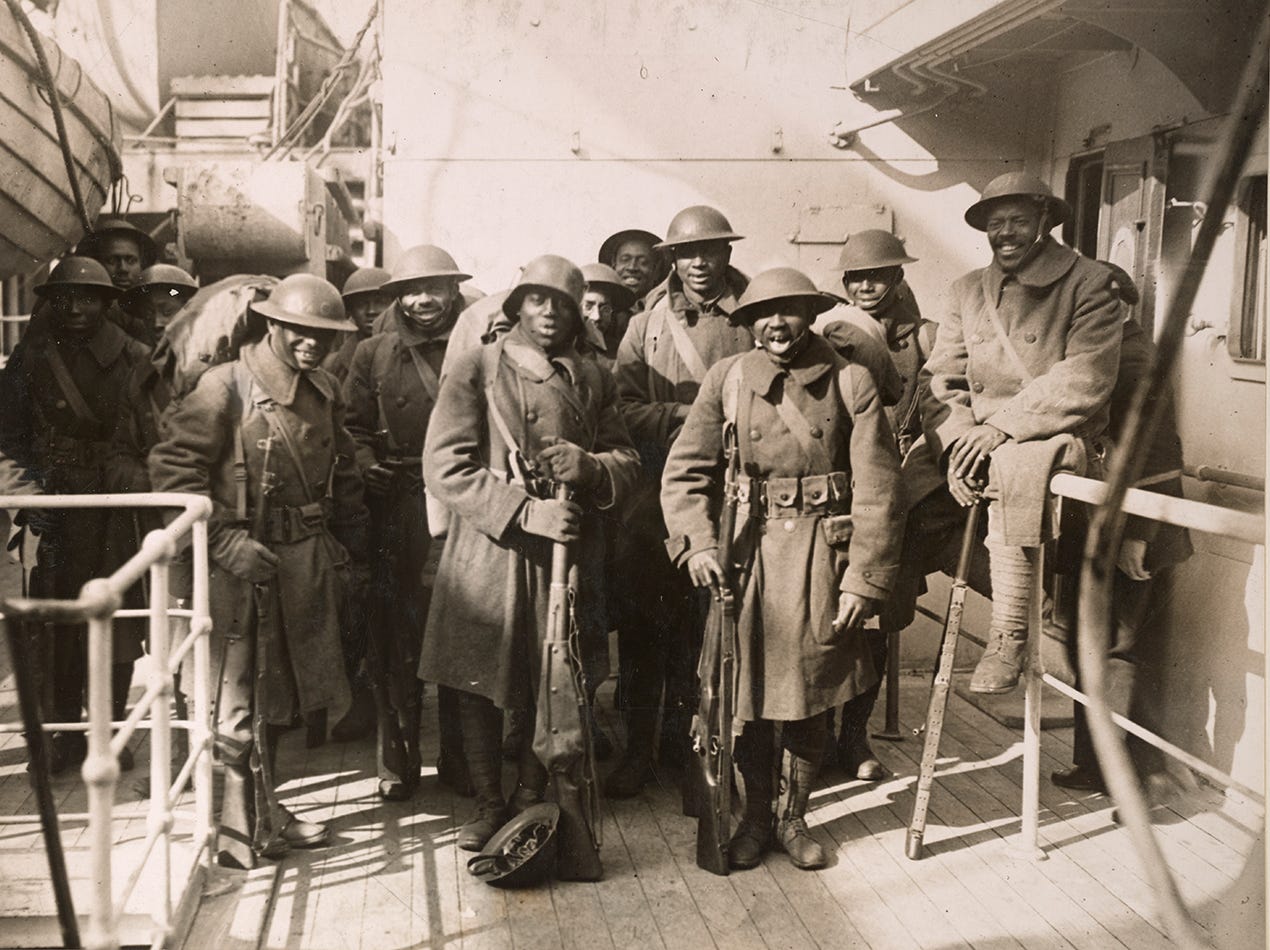
One of the most famous units of the Doughboys was the 369th Infantry Regiment of the 93rd Division. Many from this unit enlisted with the hope that their patriotism and service would lead to better treatment at home. Before leaving for war in Europe, the regiment was denied permission to participate in a farewell parade for the New York National Guard. NY’s National Guard was known as the Rainbow Division, however, they were denied because “black isn’t a part of the rainbow.” Nonetheless, without a parade, the 369th Infantry Regiment made a name for themselves while fighting in France. They wore rattlesnake insignias on their Doughboy uniforms, so initially they nicknamed themselves the “Black Rattles.” When white American soldiers refused to fight along with them, they were sent to the French 16th Division. The French, who were struggling at the time, would nickname the “Men of Bronze”, but it would be the name the Germans gave them that would ultimately stick…the Harlem Hellfighters.
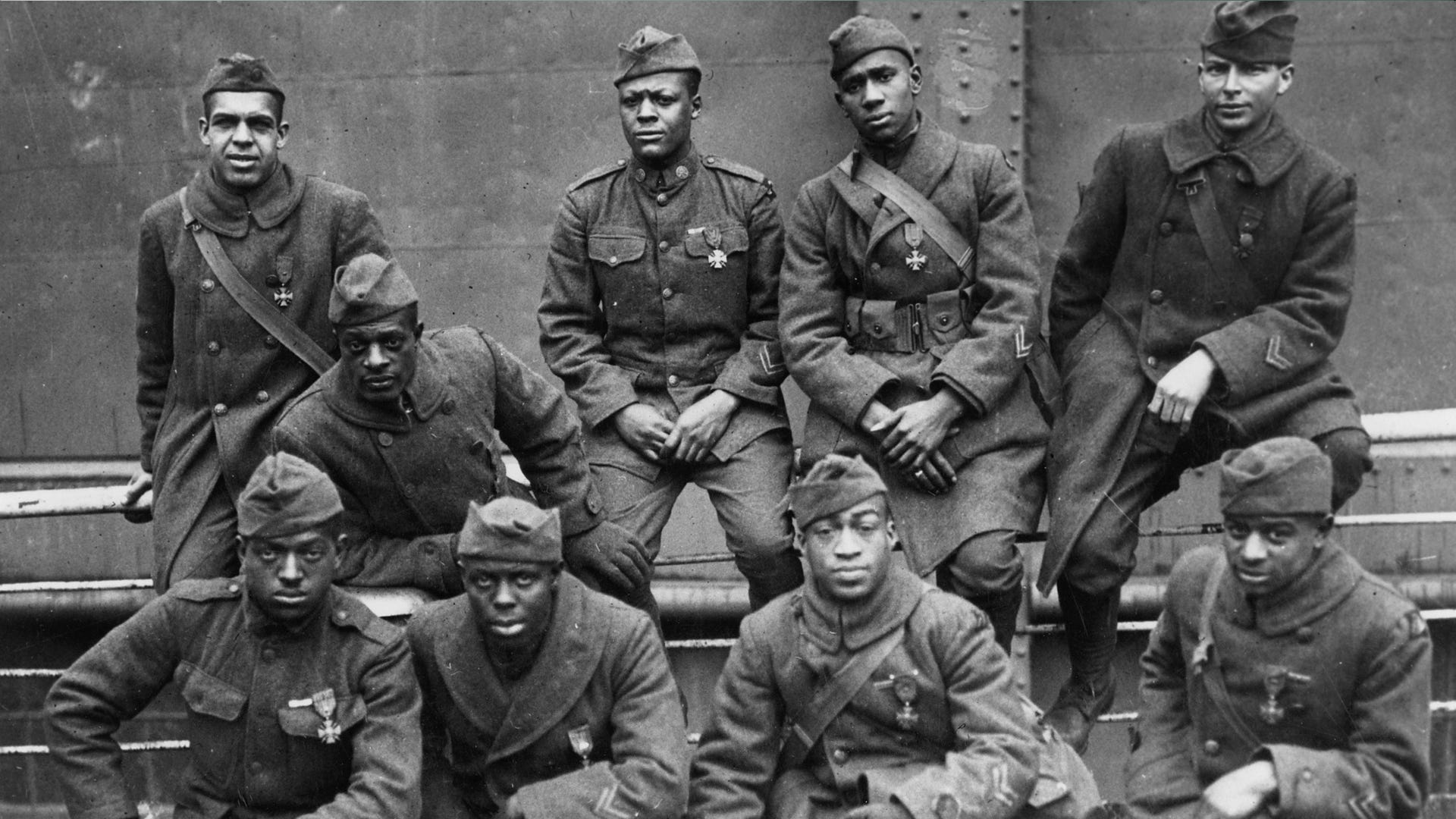
The Harlem Hellfighters regiment consisted of several thousand soldiers. They would fight alongside the French front-lines for 191 days, the most continuous amount of time any American combat regiment of its size. While they faced discrimination amongst even their American generals, the Harlem Hellfighters were a blessing to the French, whose government would award 171 soldiers the Croix de Guerre, a military honor. You can see the Croix de Guerres on the soldiers above, it’s the medal crosses. While the unit was known to be wildly successful and extraordinary, they endured 1,400 total casualties, the most of any American unit in WWI.
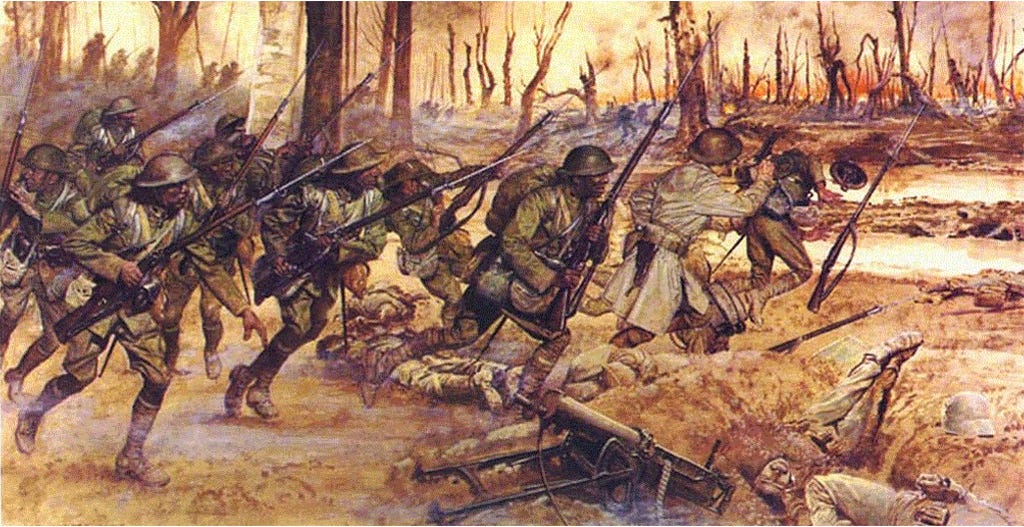
The Harlem Hellfighters were a part of the Meuse-Argonne Offensive. While much of World War I was fought in dug-in trenches, the Meuse-Argonne Offensive was one of the final Allied offensives of the war. The offensive lasted 47 days from September 26 to November 11, 1918 (Armistice Day). The Meuse-Argonne Offensive saw 350,000 casualties, including 26,277 American lives. About 1/4th of those who died in the Meuse-Argonne Offensive were killed by poisonous gas. For the Harlem Hellfighters, the offensive would cost them 851 men.
(Source: ABMC)
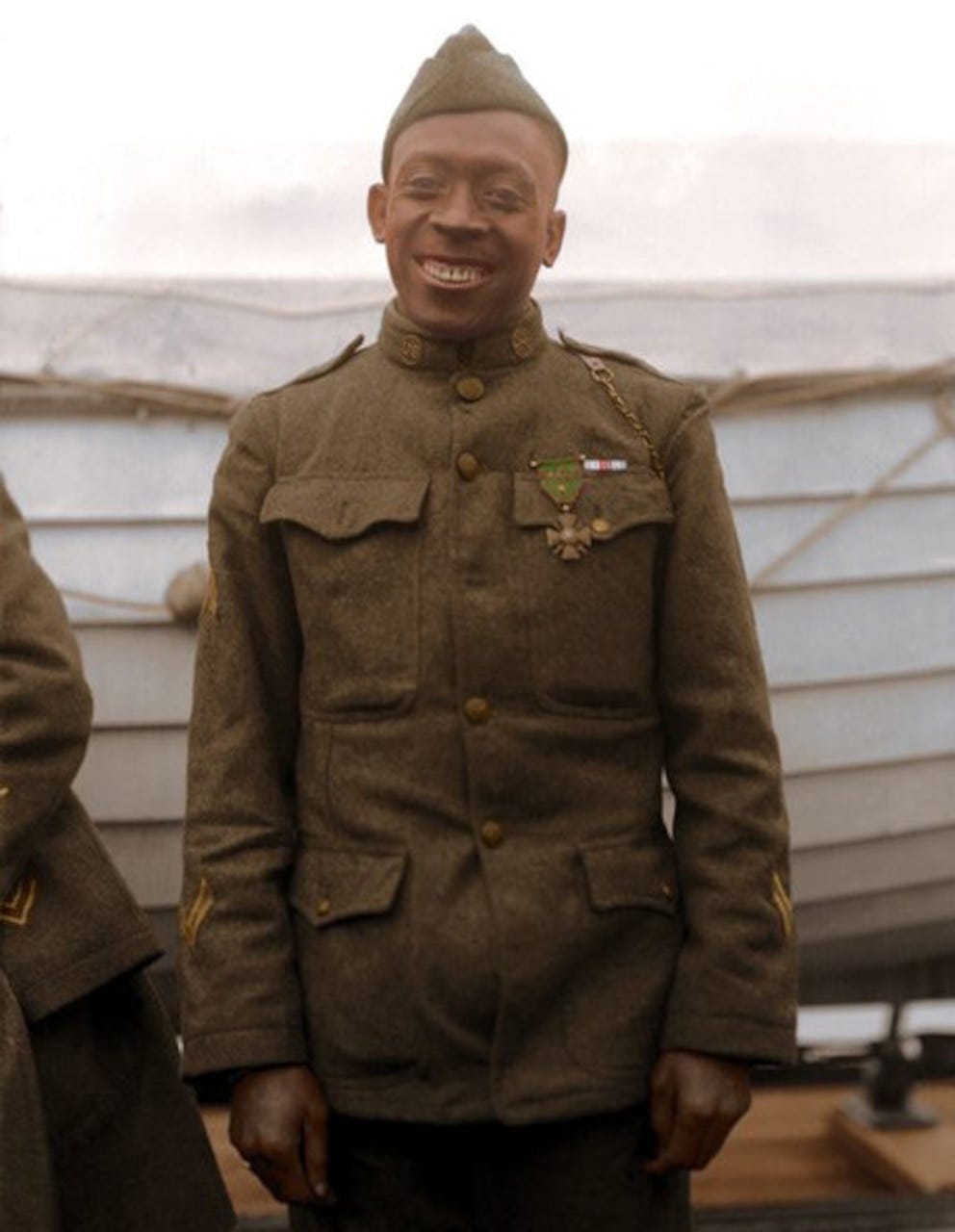
One of the most famed Harlem Hellfighters was Private Henry Johnson. Born on July 15, 1892, in Winston-Salem, North Carolina, the Johnson family moved to Albany, New York, when he was in his teens. While living in the capital of New York, Johnson worked several jobs, including a soda mixer, coal-yard laborer, chauffeur, and redcap porter at Albany’s Union Station. A redcap porter was someone who would wear a red hat to stick out at train stations, and their job was to help passengers with their luggage. Henry Johnson enlisted in June of 1917, and less than a year later, his military legend began. At around 2 AM on May 15, 1918, Henry Johnson and his fellow Harlem Hellfighter comrade, Needham Roberts, were on observation-post duty forward of the main line when 25 German soldiers attempt to sneak up on the Allies’ trenches. Johnson and Roberts somehow managed to hold them off using mostly hand-to-hand combat. Private Johnson used his gun as a club and his bolo knife once he ran out of bullets. Both Johnson and Roberts would somehow survive, as Johnson would be wounded, reportedly in 21 different places. The French made sure to give him a Croix de Guerre. When he returned to Albany from duty, Johnson worked again as a redcap porter, but he was never quite able to recover from his wounds. He sadly passed away just a decade later at the age of 36. In 1996, Private Johnson finally received some recognition being granted the Purple Heart. In 2002, he was awarded the Distinguished Service Cross, and in 2015, Private Henry Johnson was posthumously awarded the Medal of Honor.
(Source: NPS)
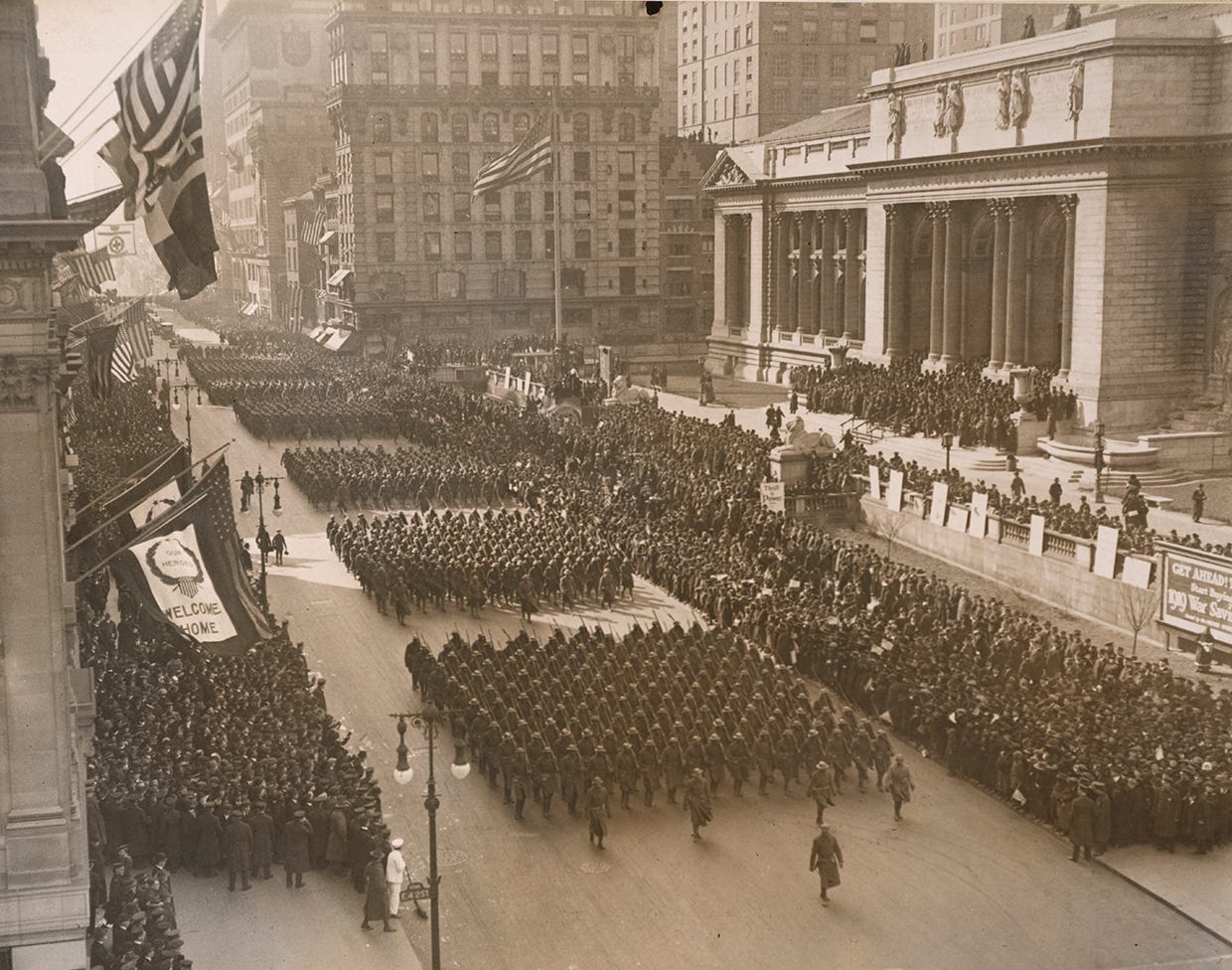
With all their days in combat action, the Harlem Hellfighters were the first combat unit of New York to return home. On February 18, 1919, the regiment that wasn’t allowed a farewell parade received a victory parade down 5th Avenue and 42nd Street, outside the New York Public Library. Thousands of New Yorkers of all races turned out in huge numbers in celebration. Unfortunately, the Harlem Hellfighters’ fame was short-lived, and after the patriotic enthusiasm for WWI had passed, so did much of the hope for better treatment in their own home country. For nearly a century, the Harlem Hellfighters’ contributions were largely lost from America’s national consciousness. Their story was revisited during the opening of the Smithsonian’s National Museum of African American History and Culture.
The Doughboys, Donut Girls, and Harlem Hellfighters are a huge reason why we have this 3-day weekend.
Game 47
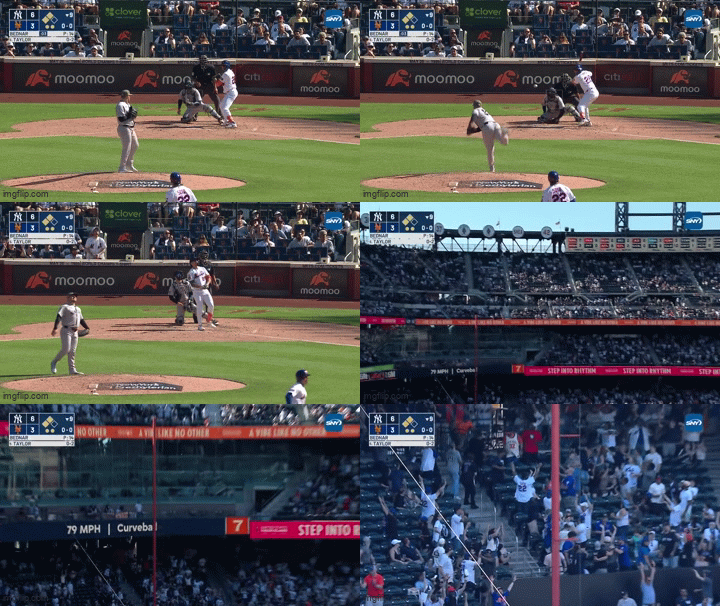
- In the rubber match with the Mets, Elmer Rodriguez returns to the bigs to replace Max Fried for a spot start while the southpaw is on the IL. The Yanks squander two runners in scoring position with two outs in the first two innings, but get on the board first with a Ben Rice solo shot. Rodriguez can’t hold the lead but gets out of a bases-loaded jam in the 4th, his day would be done by the 5th. Yanks take a 5-1 lead in the 6th, when Anthony Volpe gets a 2 RBI base knock, Amed Rosario hits a sac fly, and Volpe scores when Bo Bichette drops the 3rd out. The Yankees bullpen can’t hold the lead as Jake Bird gives up two runs in the next half inning and David Bednar blows the save in the 9th. The game ends on Volpe and Max Schuemann colliding on a weak grounder with the infield in. Bad loss.
Game 48
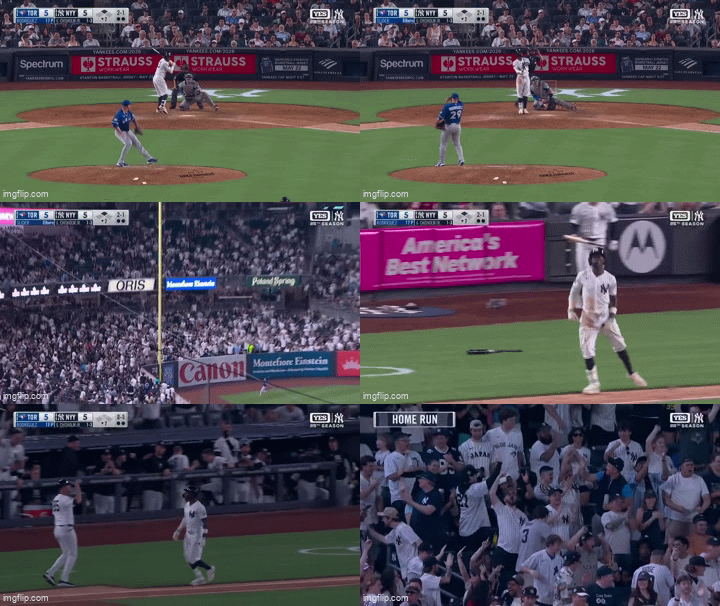
- The Yankees host the Blue Jays in the Bronx for a midweek 4-game series. Paul Goldschmidt hits yet another leadoff home run on the first pitch of the bottom of the 1st. Ryan Weathers gives up a 3-run homer to Ernie Clement in the 4th. Volpe doubles for the 2nd straight game and scores a nice slide at the plate as the Yankees later tie things at 3-3 on a Goldschmidt RBI double. Weathers pitches into the 6th inning but allows 5 runs. Cody Bellinger hits a 2-run homer in the 7th to once again tie things up and Jazz Chisholm follows up with a 2-run homer off the left field foul pole to take the lead. David Bednar again comes into close the game and is once again shaky. The Yankee closer ultimately gets a George Springer strikeout and a Vlad Guerrero Jr. groundball. Yanks win 7-6.
Game 49
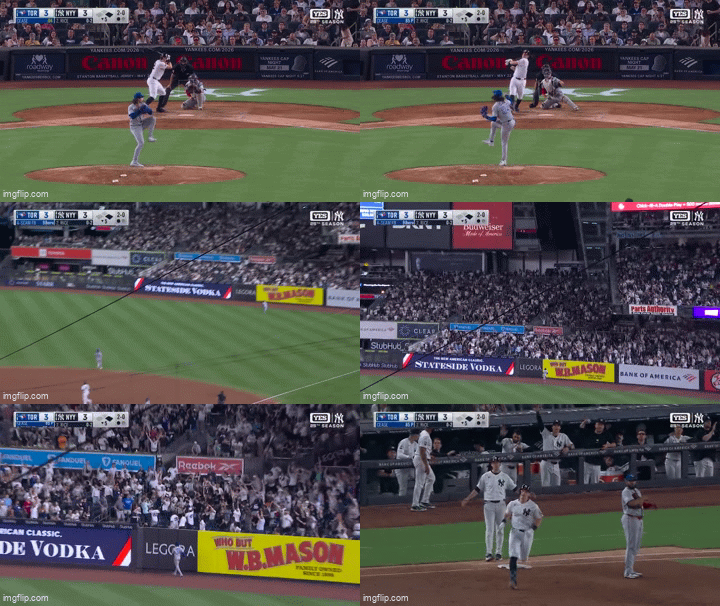
- Will Warren and Dylan Cease trade zeroes until the Jays score 3 runs in the 4th and Ryan McMahon just so happens to tie things back up on a 3-run homer to the opposite field. Ben Rice gives the Bronx Bombers the lead in the 5th on a 2-run shot, his 16th of the season. Up 5-3 in the 9th, the Yankees turn to Camillo Doval after Bednar has thrown the past two days. Doval, like Bednar, fails to throw a clean final inning by making it another nailbiter, but the Yanks hold on to win 5-4.
Game 50
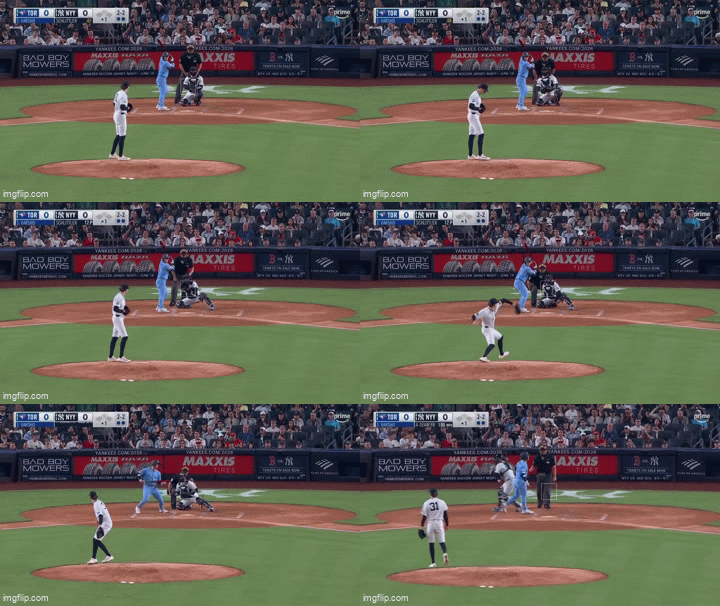
- Cam Schlittler and Trey Yesavage trade zeroes into the 7th inning until the Jays score two runs. The Yankees’ best pitcher this season went six innings with 7 strikeouts, but couldn’t get any run support from a lifeless lineup that didn’t muster a run until the game’s second-to-last out. This team has way too many automatic outs, which gets amplified when Aaron Judge isn’t hitting a home run every other day. Completely wasted another good start from Schlittler, 2-1 loss.
Game 51
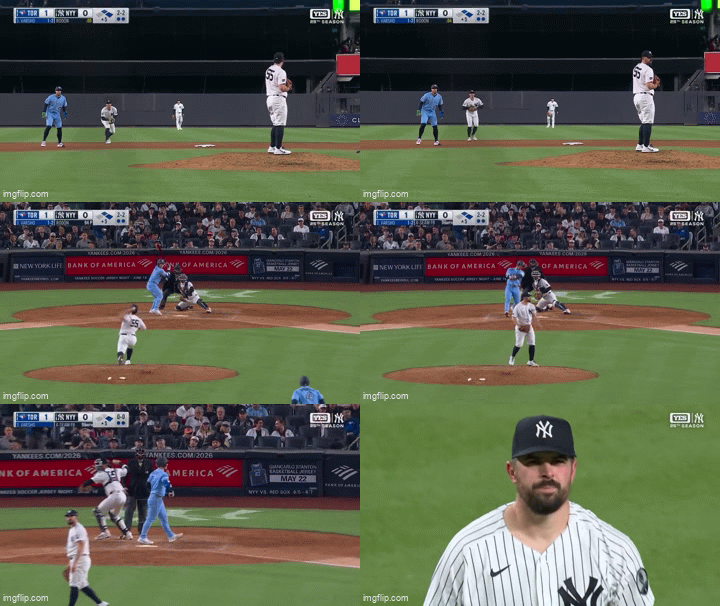
- In his 3rd start of the season, Carlos Rodon gives up one run in the 1st inning, but settles in to give the Yankees 5 innings with 7 Ks and no further runs allowed. Unfortunately, the Yankees’ lineup is once again asleep. If opponents keep the ball in the ballpark, this offense is terrible. Been the same story since Giambi. Yanks lose 2-0.
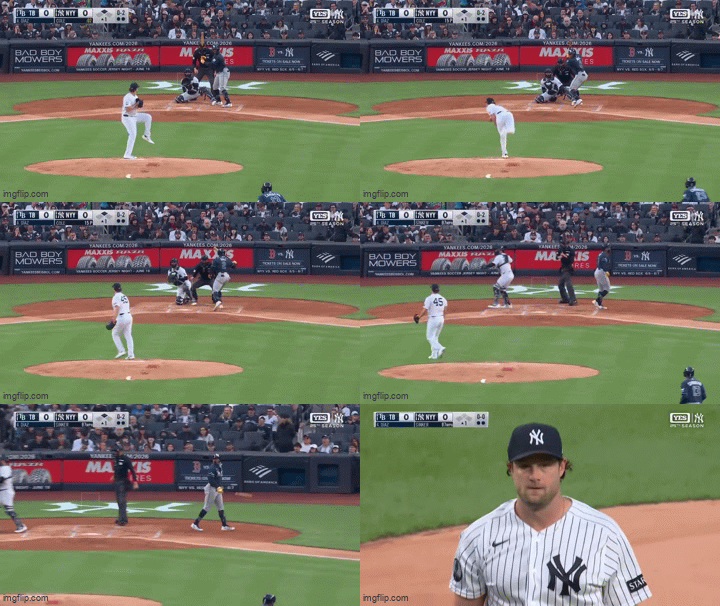
Game 52
- Facing the 1st place Rays, Gerrit Cole makes his first start since Game 5 of the 2024 World Series. He pitches a beautiful 6 innings of shutout ball and exits after throwing 72 pitches with a 1-0 lead, which happened on a rare Austin Wells solo shot. Of course, this bullpen blows the lead as this time it’s Tim Hill who gives up 4-runs in the 8th, one of which was caused by a Jose Caballero error to start the inning. The Yankees put together a fake 9th inning rally that ends on the left-center warning track off the bat of Aaron Judge, who’s Oh-For-His-Last 11 and hasn’t homered in two weeks.