Stumblin' Along 4/27 '25
Gold

Gold
- A Bit about Gold
- Yankees Week 5 Notes
- YouTube Rabbithole

Alright @YouTheReader,
Today’s tune is Kiiara’s Gold. Obviously gotta cap off the weekend with a final song with gold in the title.

This hit song was released in 2015 and peaked on the US Billboard Hot 100 at #13. Despite its popularity, nobody knows what she was saying here, but it sounds cool.

Allegedly, the song was inspired while she was trying to Irish goodbye at a party...
“I was at a dinner party thing and I was leaving and I said 'bye' to everyone else, and not this one person. And then when I went to leave, and they were like, 'You're going to leave without saying 'bye?" And I either thought, or I said, 'Yeah.' That's where it came from. I was writing one day, I was just learning to write - this was three years ago - so it just fell out of my mouth….The overall message is you don't have to answer to anyone.” (Source: Billboard Magazine)

At first, the tune was going to be named W.E.L.Y.K. for the without ever letting you know line. "We decided not to because we didn't want to be trendy. 'Gold' felt like years from now it would still be relevant." Good call, there were a lot of acronym songs in the mid-2010s.
On to a bit of history about Gold…
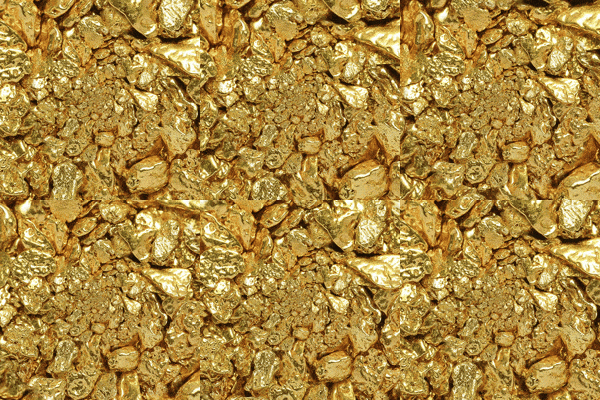
The origins of gold can be traced back to dying stars. In fact, the element of gold even predates planet Earth. It likely arrived here in meteors or cosmic supernovae around Earth was formed. Being that it’s so deeply within Earth’s crust, it takes intense heat and pressure over millions of years to create the gold deposits we associate with the element. To better understand the science behind it, check out Physical Gold.
Ancient Times
Gold goes way back in time, as it was first discovered in streams worldwide, and was the first metal known to humans. The earliest human use of gold is said to have occurred in Eastern Europe around 4000 BC. It was used decoratively and likely mined in the Transylvanian Alps. By 3100 BC, there is evidence that gold was valued and traded by Menes, the founder of the first Egyptian dynasty. In 2500 BC, gold jewelry was buried in the Tomb of Djer, one of Egypt’s first kings.


Ancient Egypt had an abundance of gold thanks to its Nubia region. They had so much gold in the Nubia area that they decided to invent The Shekel out of it. The coin contained two-thirds gold and one-third silver, so whatever governance made them was already learning to skim gold dust off the top. Known as the Land of Gold, Nubia was the source of the gold mines that supplied most of Egypt, Greece, and Rome with metals throughout ancient history. The Ancient Greek poet, Homer, even mentions using gold as trading currency in his works, The Iliad and The Odyssey. Homer wrote those epics around the 7th Century BC, but they were set about 1,000 years before. In 344 BC, Alexander the Great and 40,000 of his men famously went to war with the Persian Empire, as it was rich in gold. During the Gallic Wars in 58 BC, Julius Caesar brought back enough gold from Gaul that he could give 200 gold coins to each of his soldiers and still have enough extra left over to repay all of Rome’s debt. The Romans decided to issue their own gold coin called the Aureus.
Shiny Dark Ages

Once Rome fell in 476 AD, the areas of central Europe and France where gold was once mined remained untouched for about 125 years. Around 600 AD, the Byzantine Empire came in and was like, “We’re mining here again, okay? Cool.” About 75 years into the Byzantine Empire taking all the gold from Europe, the King of the Franks (French), aka Charlemagne, reclaimed Western Europe. Pope Leo III crowned Charlemagne the “Emperor of Rome” in 800 AD, which is awkward because we have since decided to call that Middle Ages reign something different, the Carolingian Empire.
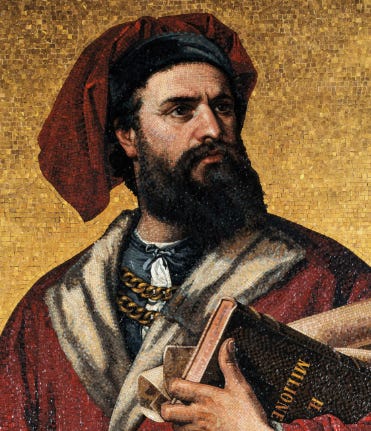
There wasn’t much going on in Medieval Europe, just a lot of people dying of the bubonic plagues, hanging out in castles, and whatnot. It was the ideal time for young people to take gap years and travel around the world, which is what Marco Polo decided to do at 17 years old. While visiting the Far East in 1250 AD, Marco…(*wait a few seconds in a distant shout*) Polo… noted that the Asian world had “gold wealth that was almost unlimited.” This line resonated with the likes of explorers such as Christopher Columbus, who was on a mission to not only find a new trade route for Asian spices but also their gold. Once Europe decided to get out of the Dark Ages in the 1500s, King Ferdinand of Spain told his explorers to, “Get gold, humanely if you can, but at all hazards, get gold.” This launched massive expeditions to the newly discovered Western Hemisphere of the Americas. In 1700, Brazil would become the new hub of gold, producing the most significant amount of the metal by 1720, making up nearly two-thirds of the world’s output.
Leprechaun’s Gold

Irish folklores about Leprechauns go back as early as the 7th Century. Of course, most of their stories include them trying to trick people into giving up their gold. It wasn’t until 1888 that William Butler Yeats flipped the script of Leprechauns in his Fairy and Folk Tales of Ireland. While they were previously supposed to be devilish, Yeats depicted them more as “withered, old, and solitary” who participated in jokes, but were out to find their own lost pot of gold, rather than steal.
American Gold
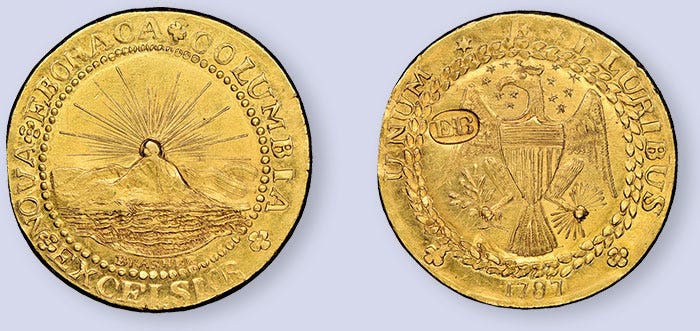
Once the United States became a thing, it wasn’t long before they entered the gold game. A fella by the name of Ephraim Brasher produced the nation’s first US gold coin in 1787. The goldsmith New Yorker happened to be Cherry Street neighbors of President George Washington, who presided in NYC for a bit before the nation’s capital would move to Washington, DC. By 1792, George Washington must’ve liked the look of Brasher’s gold coins, as he was still President when the Coinage Act (aka Mint Act) was implemented, establishing the standard proportions used for gold, silver, and copper coins.


Before the California Gold Rush, there was a Carolina Gold Rush. The first discovery of gold in the United States took place in Cabarrus County, North Carolina. It was there that a 12-year-old boy named Conrad Reed found a 17-pound nugget of gold in Little Meadow Creek. The Reed family had no Earthly idea what they had discovered, using the 17-pound nugget as a doorstop for 3 years, before Conrad’s father, John, sold the nugget to a jeweler for $3.50. That came out to about a week’s worth of pay in those days, but they could’ve gotten over $100k in today’s equivalent just for a chunk of the nugget. The Reed family began looking for more gold in their family creek, and their neighbors helped join in the search. For the early 1800s, Carolina miners sifted through its streams and rivers, recovering about $1 million worth of gold annually. North Carolina supplied all of the nation’s domestic gold coined US Mint until 1849.
(Source: Explore Cabarrus)
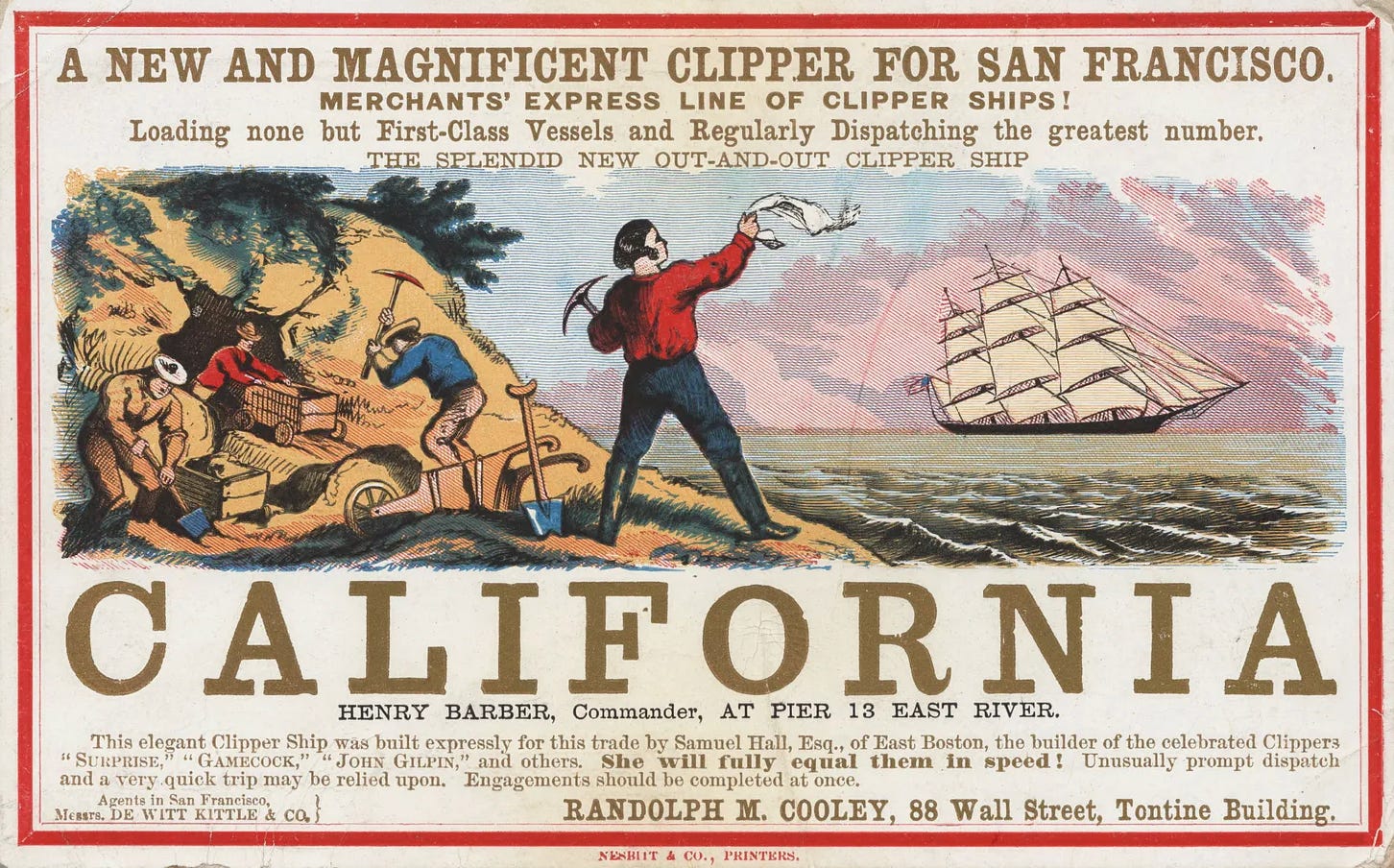
In 1848, a carpenter named John Marshall found flakes of gold while working on John Sutter’s water-powered sawmill built along the American River in Coloma, California. By the summer of 1848, 4,000 gold miners rushed to the area. Within a year, another 80,000 “forty-niners” joined them. While very few of the miners actually struck gold, over 750,000 pounds of gold were discovered during the California Gold Rush. The peak year during the Gold Rush was 1852, when prospectors found $90 million worth of gold, equivalent to $2.7 billion today. The last American Gold Rush occurred in 1898, when gold was discovered in Klondike, Alaska.
Fun fact: We don’t get Klondike Bars without gold. The Vanilla Ice Cream Chocolate Melt Company was established in 1922 and named after the Klondike River Gold Rush.
Gold Standard
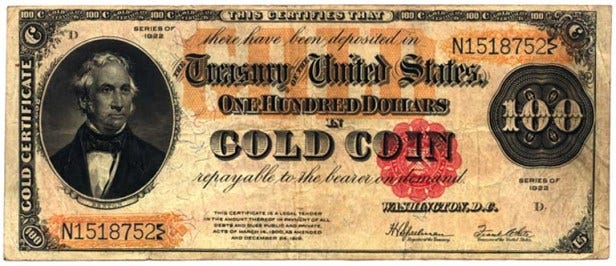
The 1900 Gold Standard Act officially committed the US to maintaining a fixed exchange rate in relation to other countries on the gold standard. Essentially, the act made the US dollar equal to 25.8 grams of 90% gold. Gold was unofficially this standard since the 1870s when the US eliminated silver as a standard of value, but this made it officially official. In 1913, the US Congress issued the Federal Reserve Act, introducing the Federal Reserve System as the government's central bank. The Federal Reserve Act also required that 40% of the cash circulating around be backed by gold reserves.


In the Gold Reserve Act of 1934, President Franklin D. Roosevelt reduced the value of the American dollar by increasing the price of gold to $35 per ounce. (Previously, an ounce of gold was $20.67.) FDR’s Gold Reserve Act was also notable in that it outlawed citizens' ability to exchange cash for gold. (You could no longer walk into a local bank and ask for a gold nugget.) This move effectively got the US off the Gold Standard domestically, and by 1968, American cash no longer was backed by Gold Reserves. It wouldn’t be until President Richard Nixon, in August of 1971, that the US terminated the conversion of officially held foreign dollars into gold. This effectively led to getting the whole world off the Gold Standard.
(Source: National Mining Association)
Gold Today
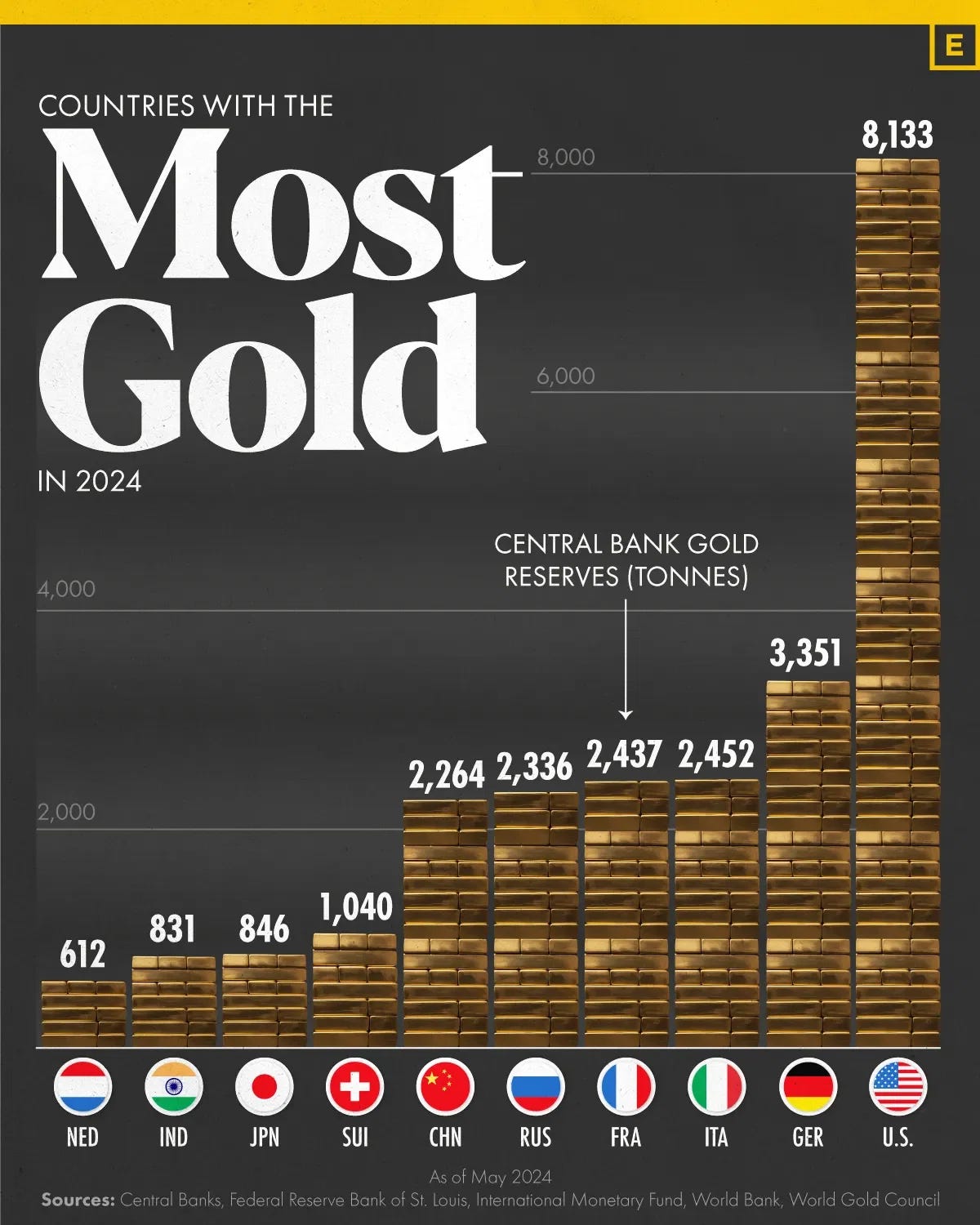
As of last year, the United States still has the most vaulted tons of gold globally. Private gold ownership was reinstated in 1975 after it had been illegal for Americans to own gold from 1933 to 1974.
That’s enough about gold for today…
Game 22 (4/20)
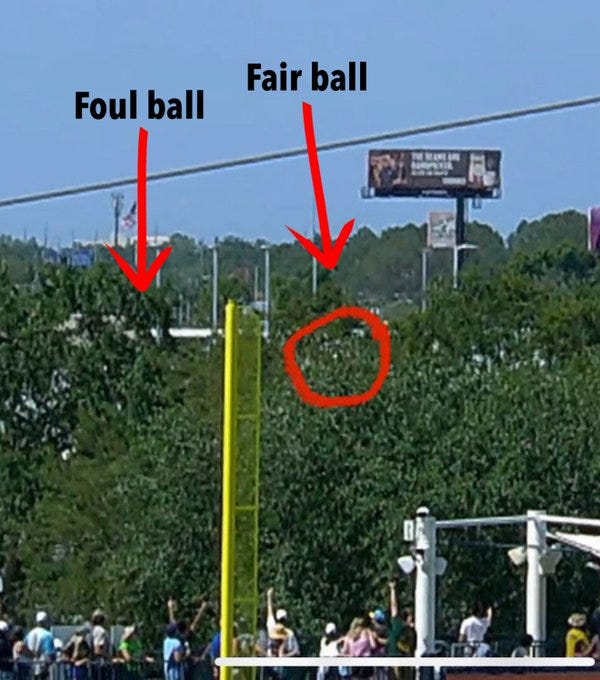
- Missed the game celebrating Easter and my Uncle T’s 50th Birthday. He was a bit hungover and Shane needs to be better at finding Easter Eggs next year. Through the grapevine (& Drew), I heard that Max Fried almost pitched a no-hitter and the umps robbed Aaron Judge of a home run. Some things are bigger than sports, the Yanks won 4-0 to take 3 out of 4 in Tampa Bay.


Game 23 (4/21)
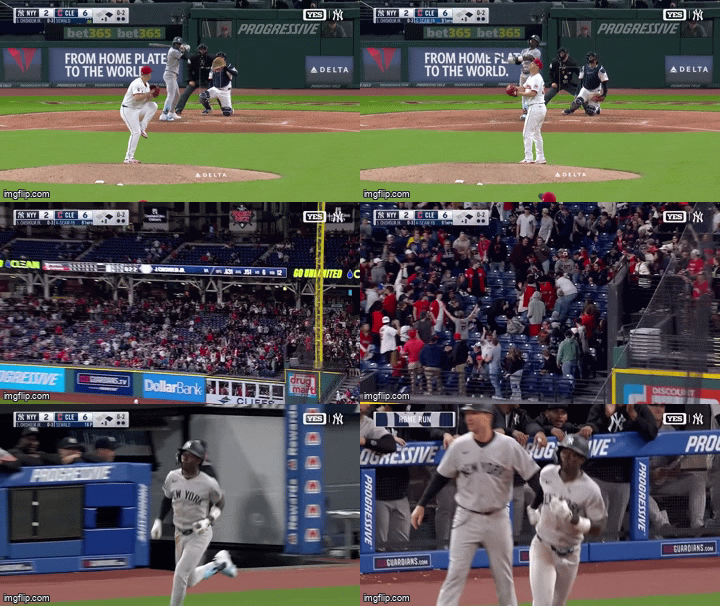
- Yanks are in Cleveland. The Indians strike first with a 4-run 3rd inning as Clarke Schmidt gets roughed up. Aside from an Aaron Judge double, the Yankees can’t touch Gavin Williams until The Martian launches a 2-run shot in the 7th. In the 8th, Paul Goldschmidt hits a chopper off the 3rd Base bag for a single, which leads to Jazz hitting a 2-run drive to make things interesting. In the 9th inning with two out, the Yankees show some fight by bringing Aaron Judge to the plate as the game-tying run, but Cap strikes out. Yanks lose 6-4.
Game 24 (4/22)
- Will Warren has a strong response to his awful previous start in Tampa. The 25-year-old rookie was cruising until the beginning of the 6th inning when he faced the Guardians’ top of the order a 3rd time with Steven Kwan and Nolan Jones collecting consecutive singles. Boone turns to Mark Leiter Jr., who allows both inherited runners to score and then gives up a 3rd run unearned thanks to an Anthony Volpe error. The Yankees waste Ben Rice homering in his return from getting hit on the elbow and an Aaron Judge 4 for 4 night as they lose 3-2.
Game 25 (4/23)
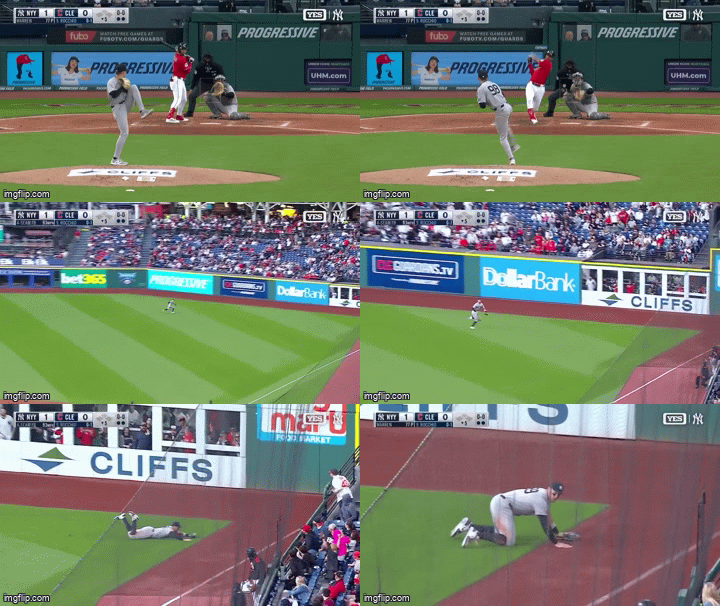
- 1 PM Wednesday afternoon game. Out the gate, Ben Rice draws a lead-off walk, Aaron Judge triples, Cody Bellinger walks, and Paul Goldschmidt doubles. Despite the fast start, the Yankees only come away with 2 runs as Jazz Chisholm, Anthony Volpe, and Austin Wells each strike out while failing to get the runners home from 2nd + 3rd. It should be 4-0 with some situational hitting. In the bottom of the 1st, Bellinger mishandles a line drive one-hopper, allowing a Cleveland run to score and Jose Ramirez to end up on 3rd base. Rice drives The Martian home in the 2nd, and after a Judge single, Goldschmidt then drives Rice in with a single of his own. With bases loaded and two out, Volpe strikes out a 2nd time. After a tense 1st inning not of his own doing, Carlos Rodon gets out of trouble in the 2nd inning to keep things 4-1. Volpe strikes out a 3rd time in the 5th inning. In the 6th, Bellinger gets thrown out at home trying to score from 1st on a two Goldschmidt double. Volpe strikes out a 4th time in the 7th. With Jazz on 2nd base, he could’ve at least attempted a bunt there, but all is for naught as Wells hits an RBI double anyway. Rodon goes a strong 7 innings with 8 strikeouts. Up 5-1, the Yankees turn to Luke Weaver in the 9th inning with Devin Williams warming up in the bullpen just in case. Weaver induced 3 warning track flyball outs that all looked like they were gone. Yanks win 5-1 and avoid getting swept in Cleveland.
Game 26 (4/25)
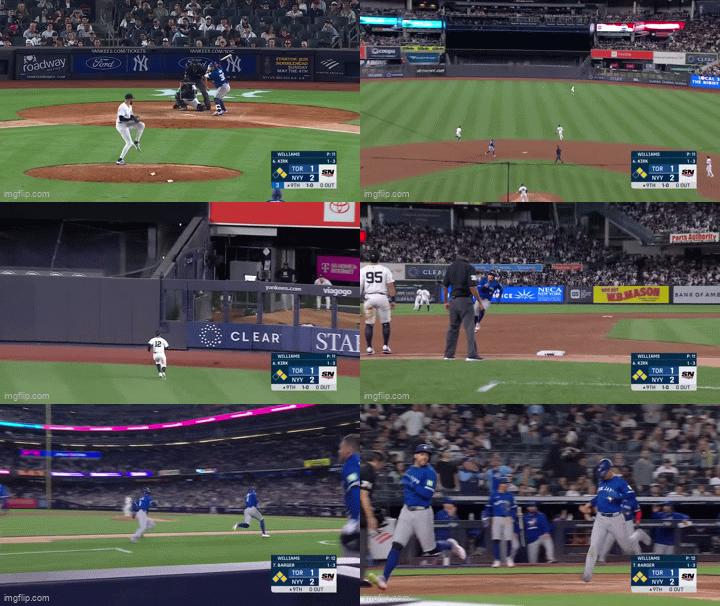
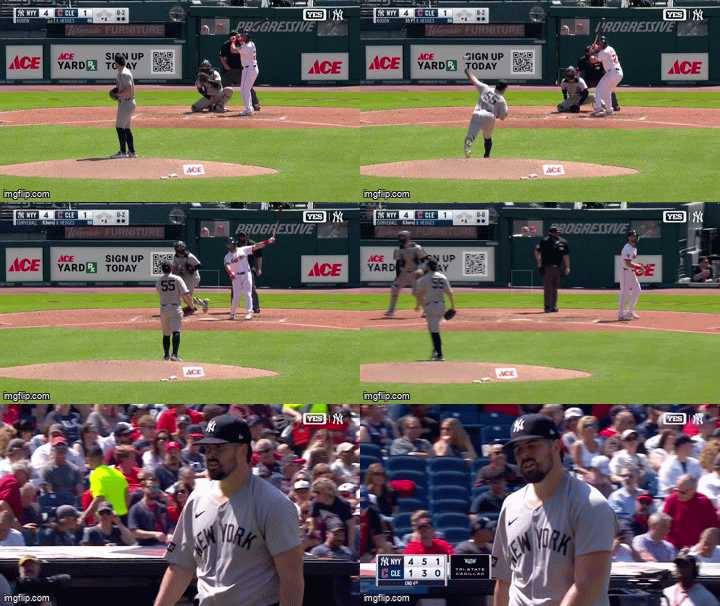
- Carlos Carrasco is on the hill for the Friday night matchup with Toronto. He gives the Yankees 5 scoreless innings before Tim Hill enters the game in the 6th and immediately serves up a solo shot to Vlad Guerrero Jr. The Yankees don’t touch the Jays’ pitching until a 7th inning rally when Anthony Volpe doubles to Right, Wells sac flies him to 3rd, and Oswald Cabrera scores him on a hard hit grounder with the infield drawn in. Yanks then take the lead in the bottom of the 8th as Cody Bellinger doubles on a pop-up hit to no man’s land, Jazz walks, Volpe gets hit, and Wells hits another sac fly. Boone turns to Devin Williams to close things out in the 9th, and he proceeds with his latest disaster of an inning. Williams blows his 2nd save in a week. Yanks lose 4-2 and are 15-11.