Stumblin' Along 10/12 '25
Disarm

Disarm
- A Bit About Alfred Nobel
- Yanks Offseason Keep or Cuts?
- YouTube Rabbithole
Alright @YouTheReader,
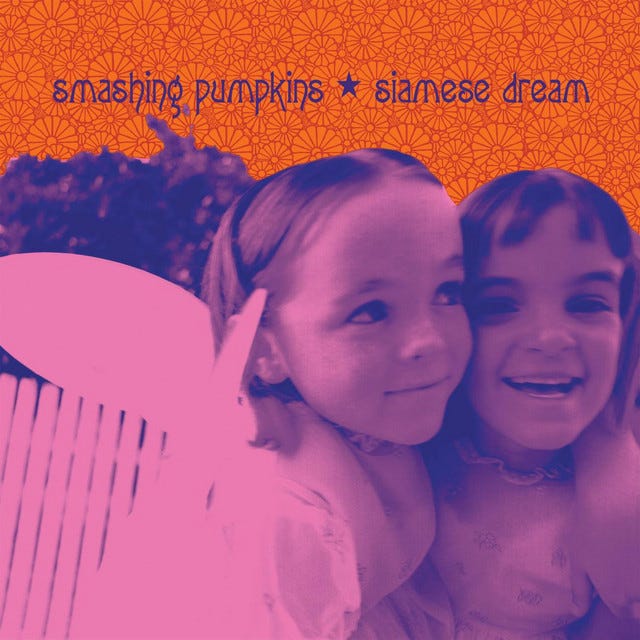
Today’s tune is The Smashing Pumpkins’ Disarm.

Gotta be honest, I picked this song because of the title and pumpkins for October. The lyrics are pretty bleak, but the instruments may make you smile. In some versions of this song, Billy Corgan played the glockenspiel to create the chiming sound, which sorta sounds like a doorbell. Peaking at #48 on the US Billboard Hot 100 in 1993, Disarm was on The Smashing Pumpkins' second album, Siamese Dream.
(Source: SongFacts)
On to some history…
Alfred Nobel
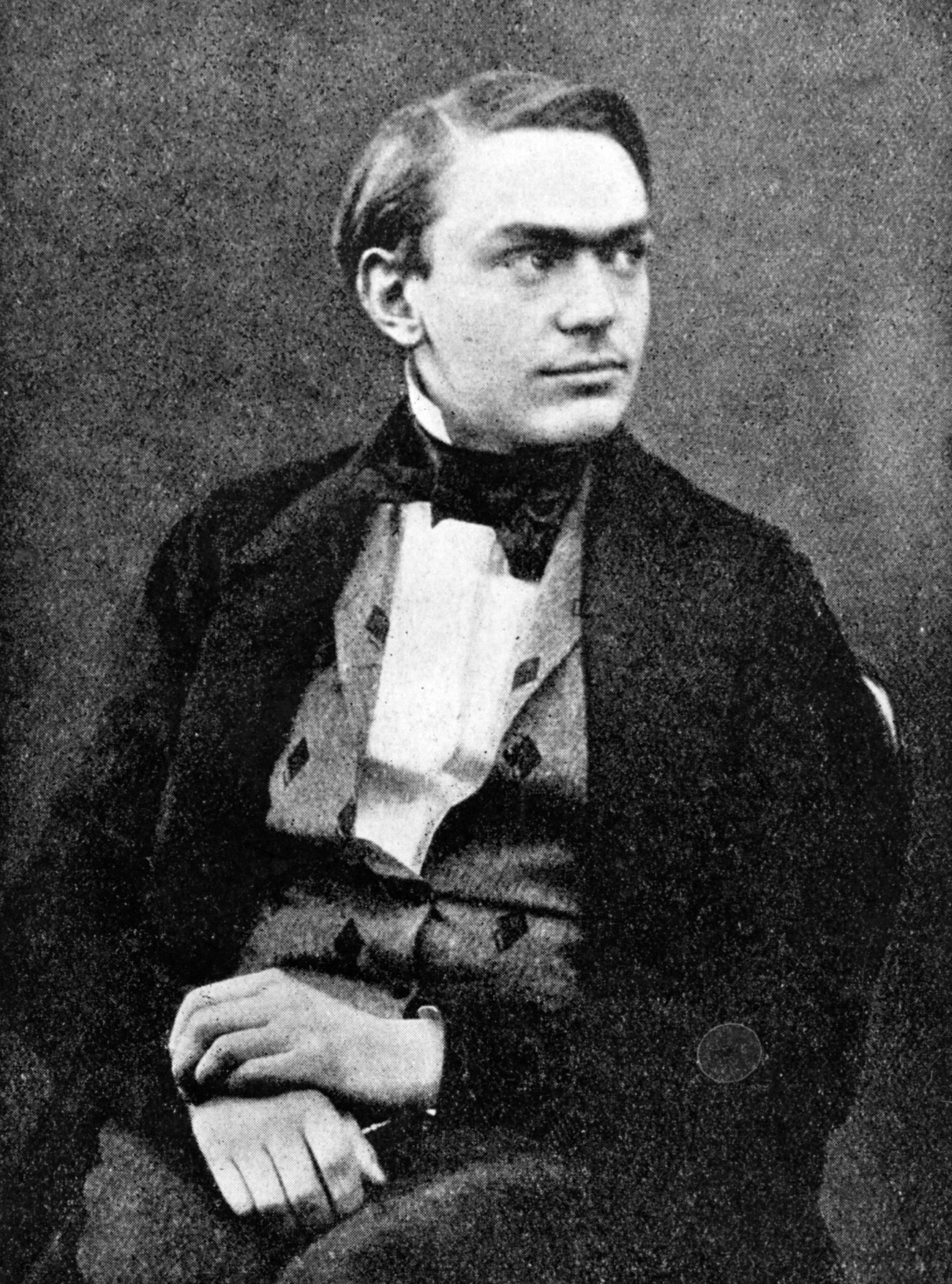
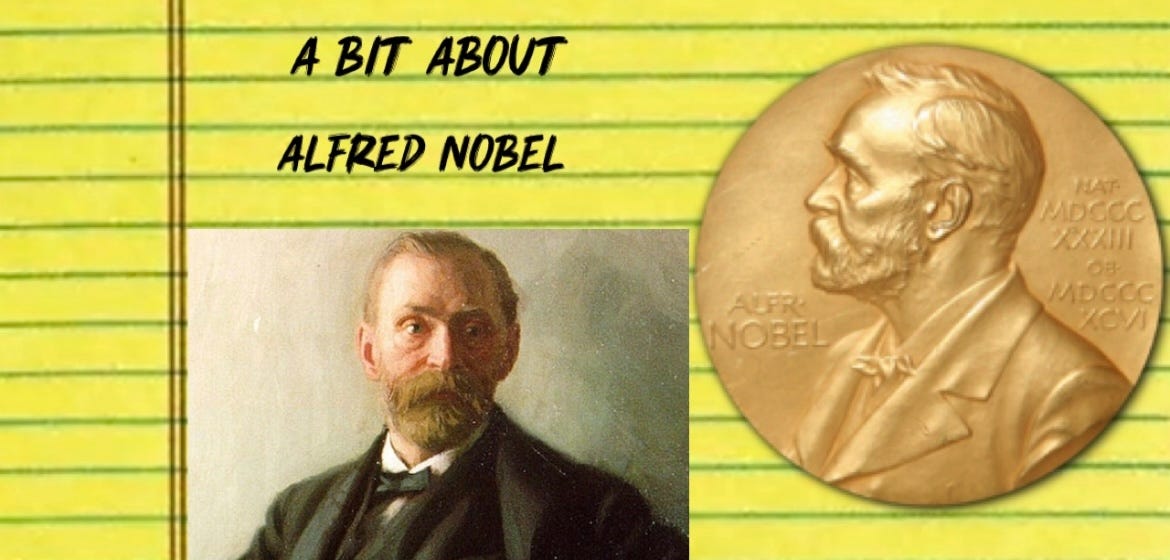
Alfred Nobel was born in Stockholm, Sweden, on October 21, 1833. He was the 4th son of Immanuel and Caroline Nobel. His father, Immanuel, was an engineer who invented plywood by realizing that several thinner layers of wood bonded together would be stronger than one single thick layer of wood. He came up with the rotary lathe used in plywood manufacturing. Alfred’s father would move from Sweden to St. Petersburg, Russia, in 1837, where he sold his inventions. Alfred, with the rest of his family, would move to Russia in 1842.
(Source: Plywood History)
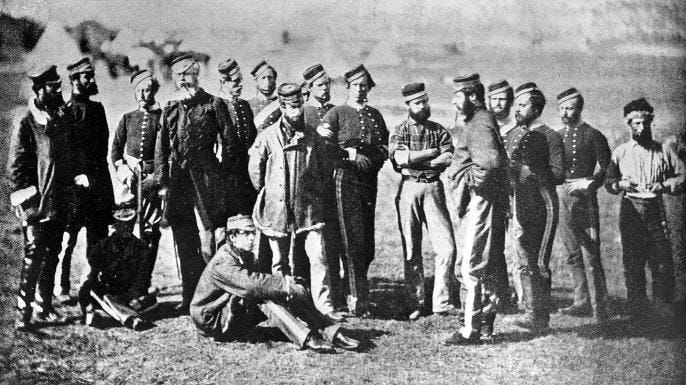
By the time he was 16 years old, Alfie Nobel was fluent in English, French, German, Russian, and Swedish. This was useful because in 1850, he studied chemistry in Paris with Professor T. J. Pelouze (famous for his discovery of guncotton). Next, Alfie Nobel visited the US, where he met Swedish-American engineer, John Ericsson, who is responsible for the screw propeller for ships. In 1852, his father asked Alfie Nobel to return to St. Petersburg to work for him at his new manufacturing company, which was booming because it made military equipment during the Crimean War. The Nobel family started experimenting with nitroglycerine, but was unsuccessful. The Crimean War lasted from 1853 to 1856, with the players involved being Russia vs. the Ottoman Empire, France, & Britain. This war was the first to feature news correspondents and battlefield photographers. Russia lost the Crimean War, eventually leading the czarist government to sell Alaska to the United States (not until 1867) because the czars needed gold to pay off the war debts. Once the war had wrapped up in 1856, the Nobel family had difficulties switching to peacetime production. As a result, the Nobel family business went bankrupt in 1859.
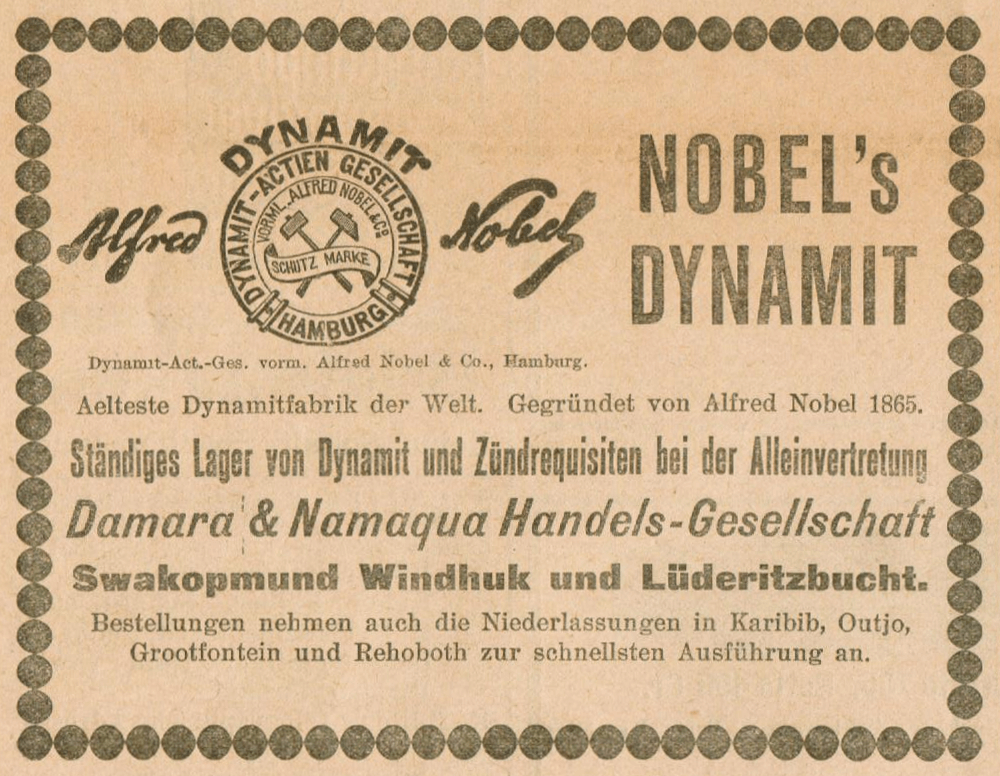
Once his parents left St. Petersburg, Alfie Nobel focused on mechanical and chemical engineering. With his father’s failure in mind, Nobel found a way to get nitroglycerine to explode underwater in the spring of 1862. This led to Alfie going all in on explosives, so he built a small factory to manufacture nitroglycerin. There, he invented an improved detonator called a blasting cap, which gave way to modern use of high explosives. In 1864, Alfie Nobel’s factory blew up, killing his younger brother Emil and others. Undeterred by the tragedy, Nobel built more manufacturing factories, leading to his 2nd invention, dynamite, in 1867. Alfie Nobel named his new product “dynamite” after the Greek word dynamis, which means “power.” Of course, the United States and Great Britain were all in on this new explosive invention, so they granted Nobel patents for dynamite in 1867. Dynamite made Alfred Nobel famous worldwide, with its primary use being for blasting tunnels, cutting canals, and building railways & roads as the United States expanded Westward.
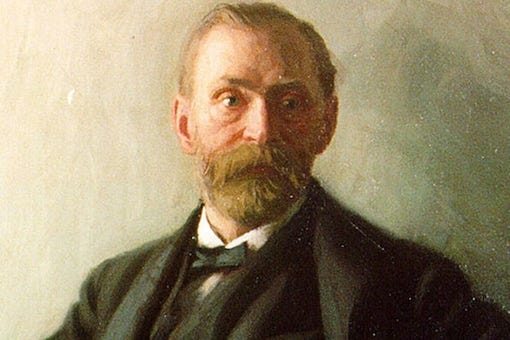
Alfred Nobel’s famed dynamite led him to launch more factories and laboratories in at least 90 different places in more than 20 countries. The man was always traveling. Victor Hugo (French writer) described Nobel as “Europe’s richest vagabond.” (A vagabond means wanderer, I Googled it.) Alfred Nobel patented 355 inventions, like artificial silk and leather, but nothing as explosive as his first two, the blasting cap and dynamite.
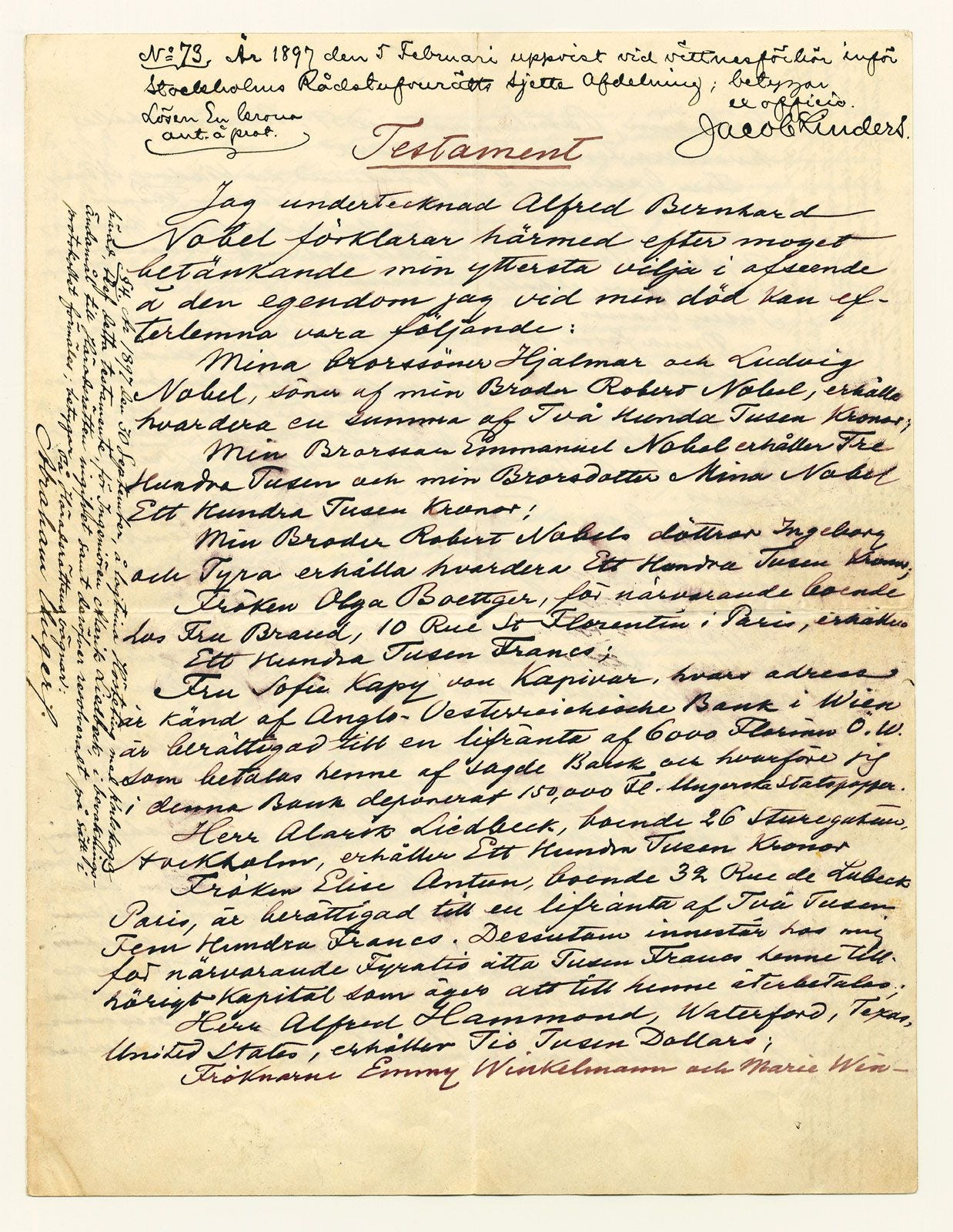
Although Alfred Nobel was a declared pacifist, his inventions clearly made war more devastating. He claimed that the destructive powers of his inventions would end war. At the time of his death in 1896, Alfred Nobel owned more than 90 factories that manufactured explosives and ammunition. In his will, he surprised his family, friends, and the general public when he left the bulk of his fortune in a trust to establish the Nobel Peace Prize. While the reason why Alfred Nobel came up with the idea is not certain, many speculate that it may have been influenced by what occurred in 1888, when one of his brothers died and a French paper mistook it as Alfred Nobel. The newspaper’s headline read: “Le marchand de la mort est mort” or “The merchant of death is dead.”
Nobel Prizes
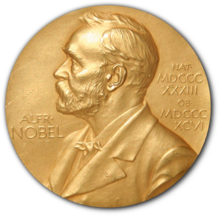
The Nobel Peace Prize was to be awarded to the person who had done most for “fraternity between nations, for the abolition or reduction of standing armies and for the holding and promotion of peace congresses”. The Nobel Prizes include not only Peace but also Physics, Chemistry, Literature, and Physiology or Medicine. From 1901 to ‘25, the Nobel Peace Prize was awarded 106 times to 143 recipients (112 individuals and 31 organizations). The first two recipients of the award were Jean Henry Dunant (founder of the Red Cross) and Frédéric Passy (a French pacifist who covered the Crimean War).
Lastly, some sports…
With another autumnal failure, here are the Yankees’ keep or cuts….
Coaching Staff
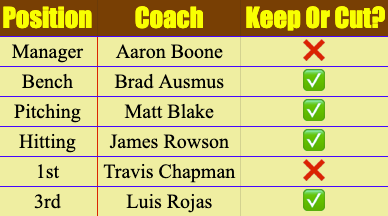
Aaron Boone is under contract through the 2027 season, so he’s not going anywhere. The Yankee manager didn’t have a glaringly bad October, but just because he wasn’t the problem doesn’t make him the solution. Boone is three regular-season wins short of 700 career victories, yet his teams are 25–27 in the postseason, and they’ve never won a series in which they weren’t the higher seed. Brad Ausmus, Matt Blake, and James Rowson can stay for now. Blake needs a bounce-back year in ‘26, he wasn’t able to develop a bullpen arm from waiver claims like he’s done in the past. I would’ve been cool with Travis Chapman continuing to collect hitting gear at 1st Base until I read on his LinkedIn that he’s also their Infield and Baserunning Coach.
Starting Pitchers
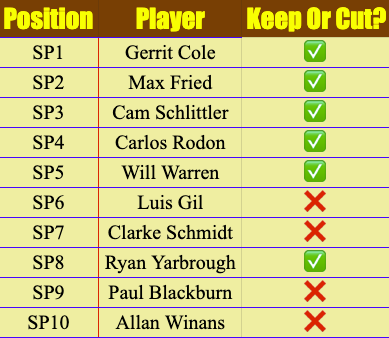
One positive heading into next season is that the Yankees should, in theory, have a better starting rotation with the return of their ace. Cole-Fried-Schlittler-Rodon are givens to make the rotation if healthy. Expect Luis Gil and Will Warren to battle out for the 5th spot. Unless Gil’s fastball is showing a bit more juice, they gotta deal him or consider moving him to a long man role (which I’m sure he wouldn’t be thrilled with). Clarke Schmidt will be out all year with Tommy John, but you can’t count on him to crack the rotation whenever he returns in 2027. Ryan Yarbrough had a nice run early in the season and would be a great depth piece if they can bring him back on a short-term deal. Expect Blackburn and Winans to be replaced by Elmer Rodriguez-Cruz, Brendan Beck, Chase Hampton, and Brock Selvidge, since they need to be added to the 40-man roster or risk being selected in the Rule 5 Draft this winter.
Bullpen
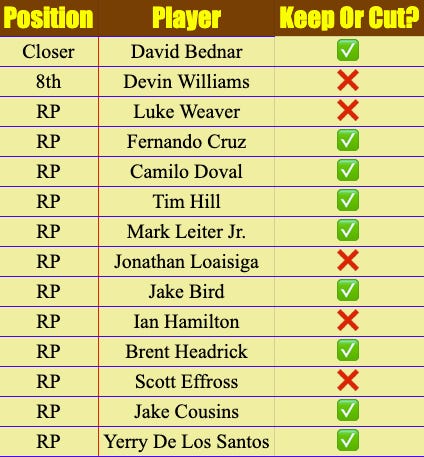
David Bednar has one more year of team control, so an extension this offseason would make some sense if they let Devin Williams and Luke Weaver walk. Everybody knows that Williams had a brutal start, and he was money by the end of the season, but I think he’ll either get paid big to close somewhere, or he’d prefer to sign elsewhere on a 1-year deal. I would’ve said to give Luke Weaver a lifetime Yankee contract after last October, but he was never the same after coming back early from a hamstring injury in July. (1.05 ERA pre-injury, 5.31 ERA post-injury) I also didn’t love that he brought up his desire to possibly become a starter again during the last week of the regular season. Cruz-Doval-Hill-Leiter Jr. are all under contract for next season and won’t get moved. The Yankees have a club option on Johnny Lasanga that they should decline because he’d probably break his arm signing the updated contract. Ian Hamilton and Scott Effross are in the minor leagues, having not been effective relievers for some time now. Hopefully, the Jake Bird experiment can be fixed over the winter. There was a brief stretch this season where I remember Brent Headrick and Yerry De Los Santos being in the circle of trust, so why not bring them back? Jake Cousins was out all year after getting Tommy John in June. Maybe he’ll be ready by the 2nd Half of ‘26 and Brian Cashman can tell us it’s like making a trade.
Infield
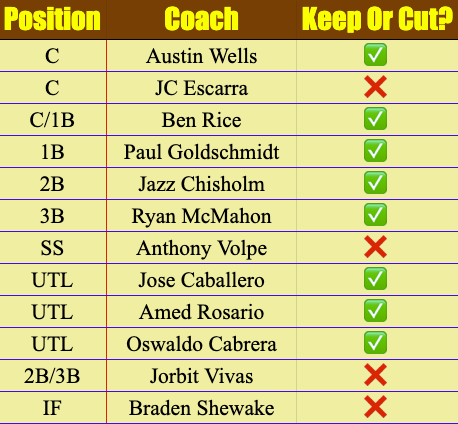
After years of questioning if Austin Wells could field in the minors, he’s become a solid defensive catcher with a serviceable bat. Not sure he’s good enough to pencil into the lineup 120 times a season though, better off in a platoon. Escarra, being a left-handed bat with average defense, makes him redundant. Ben Rice would fit well as their third catcher option in a pinch while shifting most of his focus to 1st Base. Paul Goldschmidt has stated he wants to play again in 2026. If he were willing to take a pay cut with a reduced role, he can still hit lefties, and his defense is cleaner than Rice's. If Goldy is gone, there is a right-handed-hitting Japanese corner infielder named Kazuma Okamoto who would work. Okamoto isn’t the top prize from the international free agency, but I like his swing, and he’s 8 years younger than Goldschmidt. Jazz has one more year of team control. I think you let next season play out before offering an extension to keep him motivated. McMahon’s Gold Glove fielding is enough of an asset that you can live with him hitting near the Mendoza line. If you give him an offseason to tinker with his approach, he might improve his batting average, as he doesn’t need to be hitting 25 home runs from the 8th spot in the lineup. It sucks to say this, but I think they gotta move on from the Jersey kid at SS. Volpe still has enough team control and value that you could offer him to the Twins for C Ryan Jeffers. Minnesota is rebuilding, so it would have no issue giving Volpe a fresh start, and Jeffers is a righty contact-hitting catcher with only one year left on his contract. If Volpe gets moved, the Yankees can afford to keep Caballero at SS with Cabrera as the utility guy. Amed Rosario on a short-term deal would be nice to platoon with McMahon for a full season. Jorbit Vivas deserves a fresh start on a team that’ll play him 100 games, maybe the Rockies? I had no idea Braden Shewmake was on the Yankees’ 40-man roster, but he won’t be once they start protecting guys from the Rule 5 Draft.
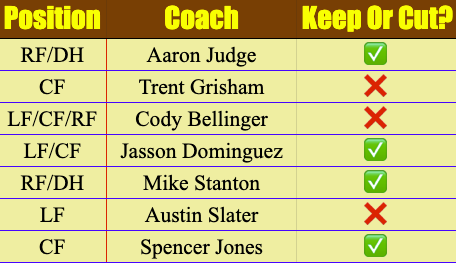
Outfield